Musical Instruments
Kobyz
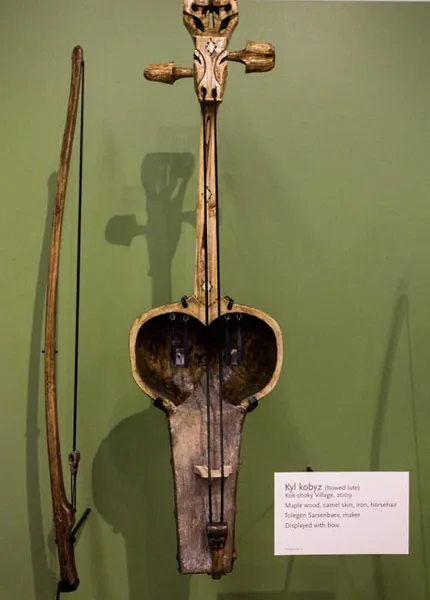
The kobyz or qobyz, also known as the kylkobyz, is an ancient Turkic bowed string instrument, spread among Kazakhs, Karakalpaks, Bashkirs, and Tatars. The Kyrgyz variant is called the kyl-kyiak). In organological terms, the traditional Kazakh qyl-qobyz is a two-stringed, fretless bowed lute whose strings are made from horsehair. Ethnomusicologist Saule Utegalieva describes it as one of the two prominent traditional lutes of the Kazakhs, alongside the plucked dombra, while noting that the kobyz historically occupied a more restricted and sacred sphere of performance. The instrument has also been examined as a bearer of historical, social and musical memory in modern Kazakhstan, where performers have interpreted it in different ways as part of discussions of Kazakh identity. The kobyz has two strings made of horsehair. The resonating cavity is usually covered with goat leather. Materials and dimensions vary among regional and historical examples. A detailed study of Kazakh instruments describes the traditional body as being carved from a single block of wood, commonly walnut or birch, with a fretless neck and an open soundbox whose lower portion is covered by an animal-skin membrane. In the instruments documented in that study, the two strings each consist of dozens of woven horsehairs and are suspended far enough from the neck that they are not normally stopped against a fingerboard. Changes in finger pressure and bow weight allow the player to produce ornaments, harmonics and contrasting timbres. Traditionally kobyzes were sacred instruments, owned by shamans and baksıs (traditional spiritual medics). According to legends, the kobyz and its music could banish evil spirits, sickness and death. In Kazakh tradition, the creation of the instrument is associated with Korkyt Ata, a legendary figure who is said to have made and played the kobyz while searching for a way to overcome death. This account is a cultural origin legend rather than a documented date for the invention of the instrument. In ritual practice, the kobyz could also be fitted with objects such as metal pendants or a mirror inside the soundbox, giving these instruments symbolic as well as musical functions.
Also on this shelf
Flute circle.
Antonello Manacorda.
See also
Uncatalogued shelfText from Wikipedia; plate via Wikimedia Commons. Text CC BY-SA 4.0; plate freely licensed (see Commons). Source record. Images and catalogue data are reproduced from open-access collections.