Musical Instruments
Elsa Barraine
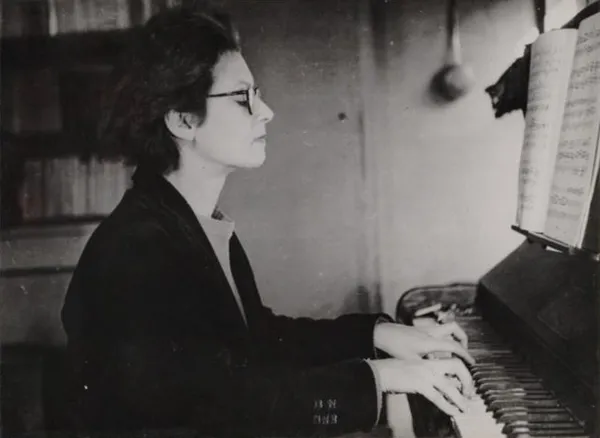
Elsa Jacqueline Barraine (French: [baʁɛn]; 13 February 1910 – 20 March 1999) was a composer of French music in the time after the neoclassicist movement of Les Six, Ravel, and Stravinsky. Despite being considered “one of the outstanding French composers of the mid-20th century,” Barraine's music is seldom performed today. She won the Prix de Rome in 1929 for La vierge guerrière, a sacred trilogy named for Joan of Arc, and was the fourth woman ever to receive that prestigious award (after Lili Boulanger in 1913, Marguerite Canal in 1920, and Jeanne Leleu in 1923). Barraine's Symphony No. 2 "Voïna", composed in 1938, was a huge success when it received its world premiere performance by the BBC Symphony Orchestra under the direction of Manuel Rosenthal at Covent Garden on July 7, 1946 during the opening concert of the 1946 ISCM Festival in London. The headline of Philip Whitacre’s review of the concert for London's Evening Standard the next day—in which he described the work as “concise, original, and alive”—was “We shall hear more of Mlle. Barraine” and the symphony was hailed by Alan Frank in The Musical Times as "expert" and as "France's best contribution" to the festival. Along with Barraine's earlier Symphony No. 1 (1931), it has been commercially recorded twice recently (by the WDR Symphony Orchestra Cologne under the direction of Elena Schwarz (conductor) for Classic Produktion Osnabrück [cpo] in July 2025 and by the Orchestre National de France under the direction of Cristian Măcelaru for Warner Classics in February 2026).
Also on this shelf
Bill Carrothers.
Glenn Miller.
See also
Uncatalogued shelfText from Wikipedia; plate via Wikimedia Commons. Text CC BY-SA 4.0; plate freely licensed (see Commons). Source record. Images and catalogue data are reproduced from open-access collections.