Musical Instruments
Byzantine lyra
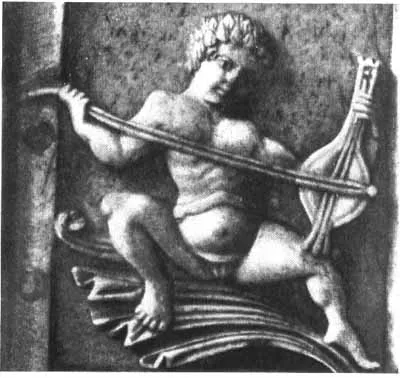
The Byzantine lyra or lira (Greek: λύρα) was a medieval bowed string instrument from the Byzantine Empire. In its popular form, the lyra was a pear-shaped instrument with three-to-five strings, held upright and played by stopping the strings from the side with the fingertips and fingernails. The oldest known depiction of the instrument is on a Byzantine ivory casket, dated to circa 900–1100; it is preserved in the Museo Nazionale del Bargello in Italy. Modern variants of the lyra are still played throughout the Balkans and in areas surrounding the Black Sea (and most of the historical territories of the Byzantine Empire), including Greece, Crete (Cretan lyra), Karpathos (Karpathian lyra), Albania, Montenegro, Serbia, Bulgaria (the gadulka), North Macedonia, Croatia (Dalmatian lijerica), Italy (the Calabrian lira), Turkey (the politiki lyra) and Armenia.
Also on this shelf
African-American music.
Cuyo, Palawan.
See also
Uncatalogued shelfText from Wikipedia; plate via Wikimedia Commons. Text CC BY-SA 4.0; plate freely licensed (see Commons). Source record. Images and catalogue data are reproduced from open-access collections.