Musical Instruments
Brian Eno
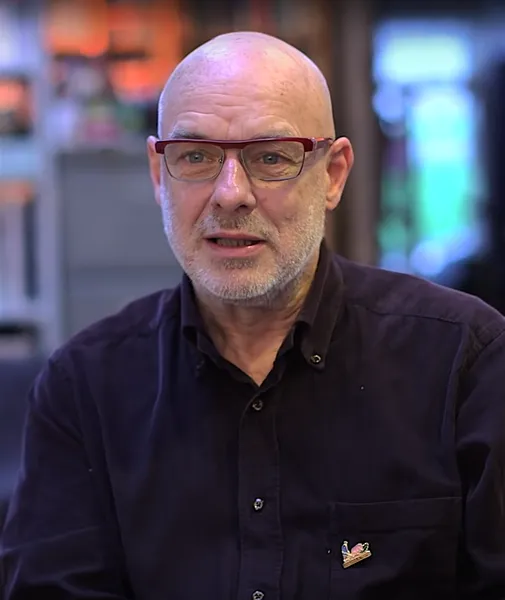
Brian Eno ( EE-no; born Brian Peter George Eno, 15 May 1948), also known under the mononym Eno, is an English musician, songwriter, record producer, visual artist, sound designer and political activist. He is known for his pioneering contributions to ambient and electronic music, and for producing, recording, and writing works in rock and pop music. A self-described "non-musician", Eno has helped introduce unconventional concepts and approaches to contemporary music. He has been described as one of popular music's most influential and innovative figures. In 2019, he was inducted into the Rock and Roll Hall of Fame as a member of Roxy Music. Born in Melton, Suffolk, Eno studied painting and experimental music at Ipswich Civic College's art school in the mid-1960s, and then at the Winchester School of Art. He joined Roxy Music as their keyboardist in 1971, contributing to their first two albums, and left in 1973. With the guitarist Robert Fripp, he recorded (No Pussyfooting) (1973) using tape-delay and reel-to-reel loops. In 1974, Eno released his first solo albums, Here Come the Warm Jets and Taking Tiger Mountain (By Strategy). Eno released the genre-fusing Another Green World (1975) the following year, which has been described as "a universally acknowledged masterpiece". Concluding his pop and rock run, he released the Oblique Strategies-inspired album Before and After Science in December 1977. At this time, Eno began to compose and release minimalist music via classically-constructed electronic composition. Several albums exemplifying this approach include Discreet Music (1975), Fripp & Eno's Evening Star (1975), the Moebius-Roedelius collaborations Cluster & Eno (1977) and After the Heat (1978), and Music for Films (1978). During 1978, Eno recorded electronic music intended to be both compositive-friendly and "as ignorable as possible". The result was the start of the Ambient series, Ambient 1: Music for Airports (1979), an album credited with coining the term "ambient music", and described as the greatest in the genre's history by Pitchfork. He went on to record the second part with Harold Budd, The Plateaux of Mirror (1980). After producing the Laraaji-released third instalment Day of Radiance (1980), Eno released On Land in 1982, the last of the series.
Also on this shelf
Don Ellis.
Christopher Hogwood.
See also
Uncatalogued shelfText from Wikipedia; plate via Wikimedia Commons. Text CC BY-SA 4.0; plate freely licensed (see Commons). Source record. Images and catalogue data are reproduced from open-access collections.