Medieval and Manuscripts
Green-Wood Cemetery
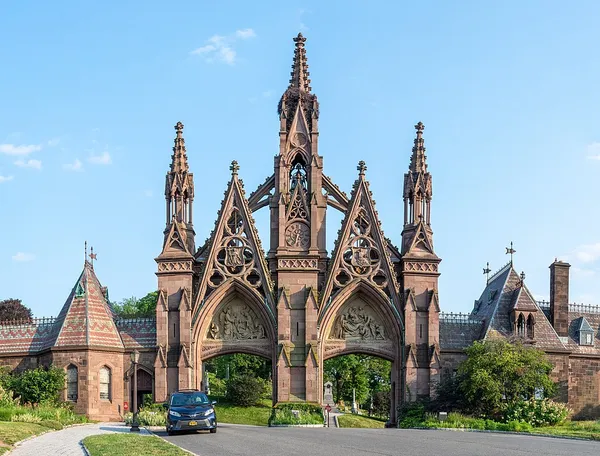
Green-Wood Cemetery is a 478-acre (193 ha) cemetery in western Brooklyn, New York City, United States. Founded in 1838 as a rural cemetery, it has 570,000 interments as of 2024, including many politicians, soldiers, artists, and business figures. The cemetery occupies a site with varied topography created by glacial moraines, particularly the Harbor Hill Moraine. The landscape design by David Bates Douglass incorporates rolling hills and lakes, including Brooklyn's highest natural point at Battle Hill. Green-Wood also includes four gates and several shelters designed by Richard Upjohn and a chapel designed by Warren and Wetmore. There are elaborate monuments to some of the dead. Green-Wood Cemetery was established at a time of rapid urbanization when churchyards in the then-separate cities of Brooklyn and New York City were becoming overcrowded. Described as "Brooklyn's first public park by default long before Prospect Park was created", Green-Wood Cemetery was so popular that it inspired competitions to design nearby parks. The cemetery had reached its final size by 1863, though landscaping and building construction continued through the 19th century. More facilities were added during the 20th century, including a new receiving tomb in 1909, a chapel in 1913, and a crematorium in the 1950s. The cemetery was nearing capacity by the 1990s, prompting its operators to begin hosting events such as concerts and tours to attract visitors. Green-Wood Cemetery is a nonprofit cemetery and conducts burials and cremations. The cemetery is open for public visitation and hosts hundreds of annual events. The Green-Wood Historic Fund, a 501(c)(3) nonprofit institution, helps organize preservation and programs. Over the years, there has been commentary on Green-Wood's bucolic nature. The cemetery is listed on the National Register of Historic Places as a National Historic Landmark, and two of its gates, its visitor center at the Weir Greenhouse, and its chapel are New York City designated landmarks.
Also on this shelf
Christianity in late antiquity.
Insular art.
See also
Uncatalogued shelfText from Wikipedia; plate via Wikimedia Commons. Text CC BY-SA 4.0; plate freely licensed (see Commons). Source record. Images and catalogue data are reproduced from open-access collections.