Medieval and Manuscripts
Ashmole Bestiary
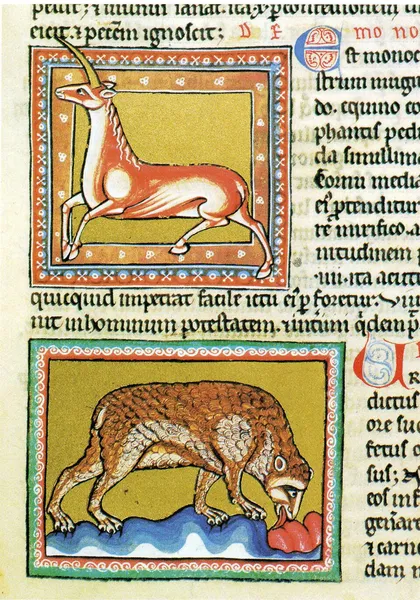
The Ashmole Bestiary, an English illuminated manuscript bestiary, is from the late 12th or early 13th century. Under 90 such manuscripts survive and they were studied and categorized into families by M.R. James in 1928. The Ashmole Bestiary is part of the Second-family of manuscript Latin bestiaries, wherein it is one of forty eight. The "Second-family" bestiary is the most popular and widely distributed type of these manuscripts. It is of English origin, with a spiritual text that catered to the prevailing culture of the church at the time. The stimulating illuminations are not just decorative, as many people were illiterate or semi-literate in England at the time. All true Latin Bestiaries take their origin from the Greek work Physiologus, though the word can colloquially be used with less specificity.
Also on this shelf
Alcázar of Segovia.
Christian ethics.
See also
Uncatalogued shelfText from Wikipedia; plate via Wikimedia Commons. Text CC BY-SA 4.0; plate freely licensed (see Commons). Source record. Images and catalogue data are reproduced from open-access collections.