Medieval and Manuscripts
Bal des Ardents
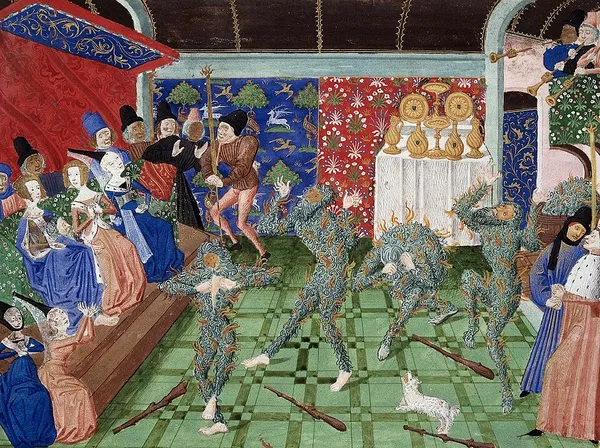
The Bal des Ardents (Ball of the Burning Men), or the Bal des Sauvages (Ball of the Wild Men), was a masquerade ball held on 28 January 1393 in Paris, France, at which King Charles VI had a dance performance with five members of the French nobility. Four of the dancers were killed in a fire caused by a torch brought in by Louis I, Duke of Orléans, the king's brother. The ball, held at the royal palace of Saint-Pol, was one of a series of events organised to entertain Charles, who had suffered an attack of insanity in the previous summer of that year during an expedition at Le Mans. The circumstances of the fire undermined confidence in the king's capacity to rule; Parisians considered it proof of courtly decadence and threatened to rebel against the more powerful members of the nobility. The public's outrage forced King Charles VI and his brother the Duke of Orléans, whom a contemporary chronicler accused of attempted regicide and sorcery, to offer penance for the event. Charles's wife, Queen Isabeau of Bavaria, held the ball to honor the remarriage of a lady-in-waiting. Scholars believe the dance performed at the ball had elements of traditional charivari, with the dancers disguised as wild men, mythical beings often associated with demonology, that were commonly represented in medieval Europe and documented in revels of Tudor England. The event was chronicled by contemporary writers such as the Monk of St Denis and Jean Froissart, and illustrated in 15th-century illuminated manuscripts by painters such as the Master of Anthony of Burgundy. The incident later provided inspiration for Edgar Allan Poe's short story "Hop-Frog".
Also on this shelf
All Saints' Church, Dunedin.
Adoration of the Magi.
See also
Uncatalogued shelfText from Wikipedia; plate via Wikimedia Commons. Text CC BY-SA 4.0; plate freely licensed (see Commons). Source record. Images and catalogue data are reproduced from open-access collections.