Medieval and Manuscripts
Armorial of British universities
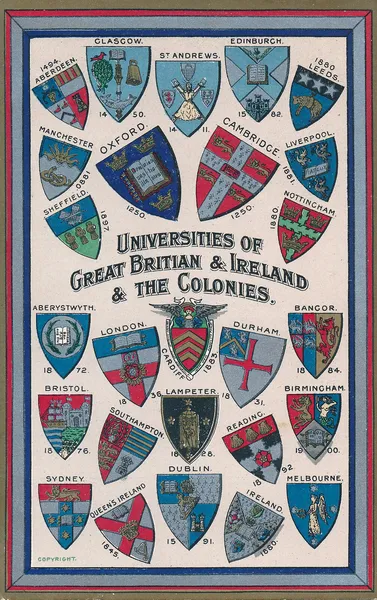
The armorial of British universities is the collection of coats of arms of universities in the United Kingdom. Modern arms of universities began appearing in England around the middle of the 15th century, with Oxford's being possibly the oldest university arms in the world, being adopted (prior to the establishment of the College of Arms) around the end of the 14th century. The earliest granting of university arms was to King's College Cambridge by Henry VI in 1449. Arms are granted in respect of England, Wales and Northern Ireland by the College of Arms and, for Scotland, by the Lyon Court. It has been suggested that new universities register arms in an attempt to appear more traditional or legitimate. As corporations, older university arms have historically been granted without a crest, however newer institutions use crests with mantling, including new colleges at older universities. The first crest granted to a university was to Leeds in 1905 while the first British university to be granted supporters was Sussex in 1962, although both Oxford and Cambridge have used angels as supporters and Cambridge has used the 'alma mater' emblem as a crest without these components being officially granted. University and college arms often incorporate, or are simply copies of, arms of their founders or local authorities. At collegiate universities, constituent colleges may bear their own arms, such as at Cambridge and Oxford. Many older coats of arms were recorded by Arthur Charles Fox-Davies in The Book of Public Arms in 1915, which also recorded some coats of arms of constituent colleges, and by John Woodward in A Treatise on Ecclesiastical Heraldry in 1894. Most university mottos are not granted with the coats of arms, instead being added by custom by the institution, an exception to this being the arms of Imperial College London. Those universities in Ireland that existed prior to independence from the United Kingdom were granted arms along the lines of other British universities; these are listed separately below. An open book (referencing historically the Christian Bible) as a symbol of 'wisdom', 'knowledge' or 'learning' is common to many arms. The Sun, a flaming torch or a lamp representing enlightenment features often, as do a wheatsheaf symbolising growth and an owl representing wisdom. A martlet, representing strenuous effort, is sometimes found.
Also on this shelf
All Saints' Church, Daresbury.
John Betjeman.
See also
Uncatalogued shelfText from Wikipedia; plate via Wikimedia Commons. Text CC BY-SA 4.0; plate freely licensed (see Commons). Source record. Images and catalogue data are reproduced from open-access collections.