Medieval and Manuscripts
Grotesque (architecture)
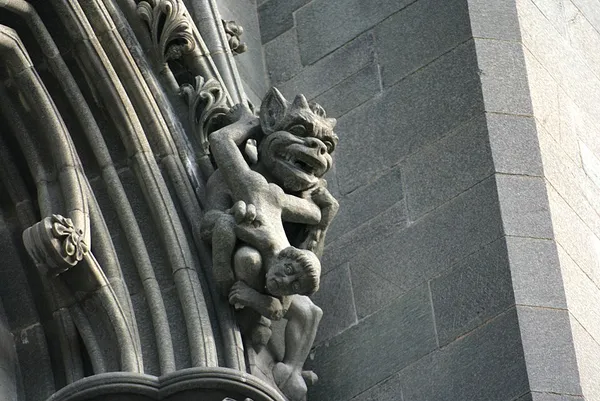
In architecture, a grotesque () is a fantastic or mythical figure carved from stone and fixed to the walls or roof of a building. A chimera () is a type of grotesque depicting a mythical combination of multiple animals (sometimes including humans). Grotesque are often called gargoyles, although the term gargoyle refers to figures carved specifically to drain water away from the sides of buildings. In the Middle Ages, the term babewyn was used to refer to both gargoyles and chimerae. This word is derived from the Italian word babbuino, which means "baboon". Grotesques often depict whimsical, mythical creatures in dramatic or humorous ways. They have historically been a key element of architecture in many periods including the Renaissance and Medieval periods and have stylistically developed in conjunction with these times. Although grotesques typically depict a wide range of subjects, they are often hybrids of different mythical, human, and animalistic features. Many scholars describe grotesques as being used to ward off evil and as reminders of the separation of the earth and the divine. Grotesques are predominantly carved into buildings of religious significance, in particular churches and cathedrals. Despite their presence in religious spaces, their anthropomorphic designs are largely not directly religious and instead are often more whimsical without religious connotations. They commonly exist on high ledges and rooftops and are frequently positioned out of view from common areas. Prominent examples of preserved grotesques exist on buildings such as the Florence Cathedral and Notre-Dame de Paris. Historically, grotesques have also had significant design influence from sculptural trends and often their architects were originally sculptors or artists. This meant that the widespread emergence of grotesques also often converged with popular art styles that existed at the time, especially the combined rise of the gothic style and the addition of grotesques in architecture. Key architects that often included grotesques as a feature in their designs included Brunelleschi and Gundulf of Rochester.
Also on this shelf
Cyril of Alexandria.
Codex Gigas.
See also
Uncatalogued shelfText from Wikipedia; plate via Wikimedia Commons. Text CC BY-SA 4.0; plate freely licensed (see Commons). Source record. Images and catalogue data are reproduced from open-access collections.