Medieval and Manuscripts
Grand Principality of Moscow
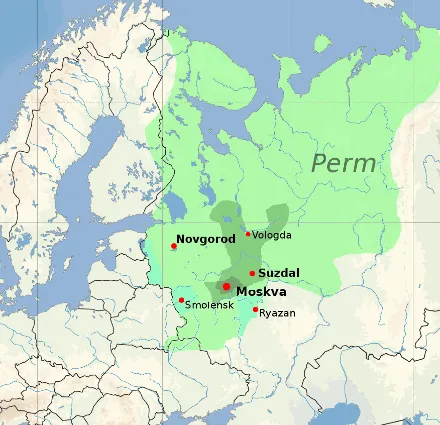
The Grand Principality of Moscow, before 1389 the Principality of Moscow, also known by the exonym Muscovy, was a late medieval Russian monarchy. Its capital was the city of Moscow. Originally established as an appanage principality in the 13th century, Moscow became the leading Russian principality and was transformed into a centralized Russian state in the late 15th century, laying the groundwork for Tsarist Russia. Moscow became a separate principality when Daniel (r. 1263–1303), the youngest son of Alexander Nevsky, received the city and surrounding area as an appanage. By the end of the 13th century, Moscow had become one of the leading principalities within the Grand Principality of Vladimir, alongside Tver. A struggle between the princes of Moscow and Tver began after Mikhail of Tver became grand prince in 1304. Yury (r. 1303–1325) contested the title and was later made grand prince in 1318 by the khan of the Golden Horde, who held suzerainty over the princes. However, Yury would lose the title four years later. Ivan I (r. 1325–1340) regained the title of grand prince and was able to collect tribute for the khan from other Russian princes, which increased Moscow's wealth. The seat of the Russian Orthodox Church was also moved from Vladimir to Moscow, establishing it as the spiritual center of Russian Orthodoxy. Ivan I defeated Tver and secured the grand princely title for his sons, Simeon (r. 1340–1353) and Ivan II (r. 1353–1359). After Ivan II's death, the title was temporarily lost until it was regained by Dmitry (r. 1359–1389), who permanently united the thrones of Vladimir and Moscow by the end of his reign. He also inflicted a milestone defeat on the Tatars in 1380, which greatly increased Moscow's prestige. As the Golden Horde declined, its hegemony was increasingly challenged. Vasily I (r. 1389–1425) greatly expanded the size of his domain, but was ultimately forced to resume paying tribute due to Tatar raids. Vasily II (r. 1425–1462) consolidated his control of Moscow after a civil war and his reign saw the Russian Church declare autocephaly in 1448. The fall of Constantinople in 1453 confirmed the nascent independence of the Russian Church. Ivan III (r. 1462–1505) absorbed nearly all of the Russian states and laid the foundations for a centralized state.
Also on this shelf
Great Hall of the University of Sydney.
Child of the Sun.
See also
Uncatalogued shelfText from Wikipedia; plate via Wikimedia Commons. Text CC BY-SA 4.0; plate freely licensed (see Commons). Source record. Images and catalogue data are reproduced from open-access collections.