Medieval and Manuscripts
Council of Chalcedon
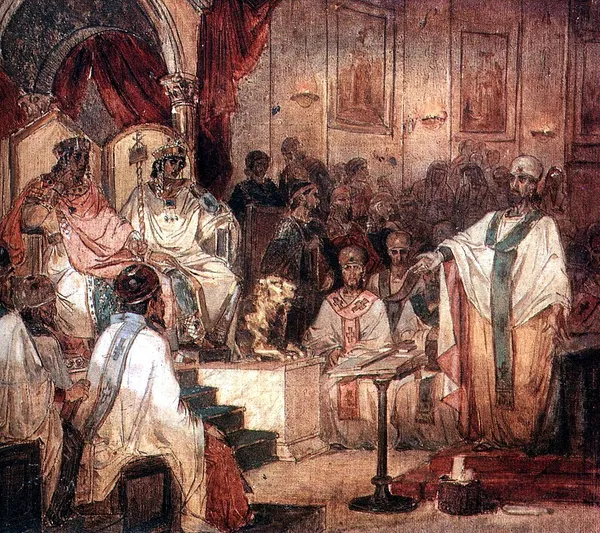
The Council of Chalcedon (; Latin: Concilium Chalcedonense) was the fourth ecumenical council of the Christian Church. It was convoked by the Roman emperor Marcian. The council convened in the city of Chalcedon, Bithynia (modern-day Kadıköy, Istanbul, Turkey) from 8 October to 1 November 451. The council was attended by over 520 bishops or their representatives, making it the largest and best-documented of the first seven ecumenical councils. The principal purpose of the council was to re-assert the teachings of the ecumenical Council of Ephesus against the teachings of Eutyches and Nestorius. Such doctrines viewed Christ's divine and human natures as separate and distinct (Nestorianism), or viewed Christ as solely divine (monophysitism). The Council of Chalcedon issued the Chalcedonian Definition, stating that Jesus is "perfect both in deity and in humanness; this selfsame one is also actually God and actually man." The Council's judgments and definitions regarding the divine marked a significant turning point in the Christological debates.
Also on this shelf
Church of St Wilfrid, Northenden.
Alypius (icon painter).
See also
Uncatalogued shelfText from Wikipedia; plate via Wikimedia Commons. Text CC BY-SA 4.0; plate freely licensed (see Commons). Source record. Images and catalogue data are reproduced from open-access collections.