Medieval and Manuscripts
Athanasius of Alexandria
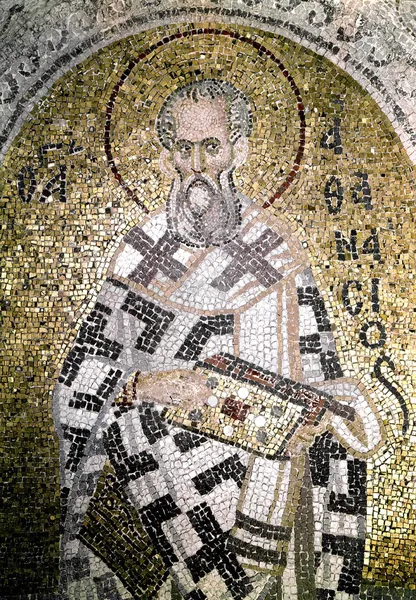
Athanasius I of Alexandria (c. 296–298 – 2 May 373), also called Athanasius the Great, Athanasius the Confessor, or, among Coptic Christians, Athanasius the Apostolic, was a Christian theologian and the 20th Patriarch of Alexandria. His intermittent episcopacy spanned 45 years (328 – 373). Conflict with Arius and Arianism, as well as with successive Roman emperors, shaped Athanasius' career. In 325, at age 27, Athanasius began his leading role against the Arians as a deacon and assistant to Bishop Alexander of Alexandria during the First Council of Nicaea. Three years after that council, Athanasius succeeded his mentor as Patriarch of Alexandria. During his reign as Patriarch, he faced repeated conflict with the Arians (including powerful and influential Arian churchmen led by Eusebius of Nicomedia), in addition to the Emperors Constantine, Constantius II, Julian the Apostate, and Valens, resulting in five exiles over a total period of 17 years. In addition to his anti-Arian polemical works, his other notable writings include On the Incarnation and his biography of St. Anthony the Great. Athanasius is venerated as a saint in the Catholic Church, Eastern Orthodox Church, Oriental Orthodox Churches, Church of the East, the Anglican Communion, and Lutheranism and is traditionally honored as one of the four Great Greek Church Fathers along with Basil of Caesarea, Gregory of Nazianzus, and John Chrysostom. His heroic efforts against Arianism have won him wide acclaim in both the East and West under the title "Father of Orthodoxy," and his writings continue to be widely read.
Also on this shelf
Aston Webb.
Holy Trinity Church, Templebreedy.
See also
Uncatalogued shelfText from Wikipedia; plate via Wikimedia Commons. Text CC BY-SA 4.0; plate freely licensed (see Commons). Source record. Images and catalogue data are reproduced from open-access collections.