Medieval and Manuscripts
Byzantine Rite
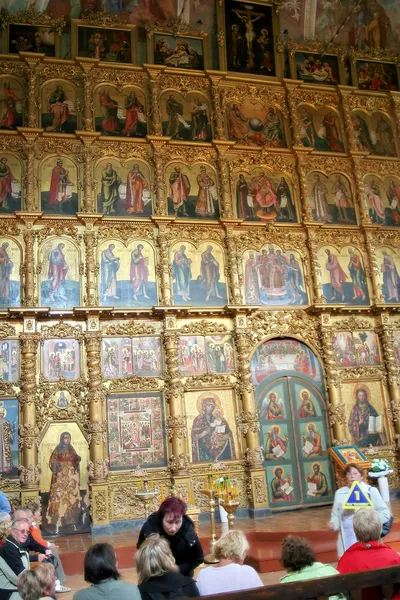
The Byzantine Rite, also known as the Rite of Constantinople, is a liturgical rite that is identified with the wide range of cultural, devotional, and canonical practices that developed in the Eastern Christian church of Constantinople. The canonical hours are extended and complex, lasting about eight hours (longer during Great Lent) but are abridged outside of large monasteries. An iconostasis, a partition covered with icons, separates the area around the altar from the nave. The sign of the cross, accompanied by bowing, is made very frequently, e.g., more than a hundred times during the divine liturgy, and there is prominent veneration of icons, a general acceptance of the congregants freely moving within the church and interacting with each other, and distinctive traditions of liturgical chanting. Some traditional practices are falling out of use in modern times in sundry churches and in the diaspora, e.g., the faithful standing during services, bowing and prostrating frequently, and priests, deacons, and monastics always wearing a cassock and other clerical garb even in everyday life (monastics also sleep wearing a cassock) and not shaving or trimming their hair or beards. In addition to numerous psalms read every day, the entire psalter is read each week, and twice each week during Great Lent, and there are daily readings of other scriptures; also many hymns have quotes from, and references to, the scriptures woven into them. On the numerous fast days there is prescribed abstention from meat and dairy products, and on many fast days also from fish, wine, and the use of oil in cooking. Four fasting seasons are prescribed: Great Lent, Nativity Fast, Apostles' Fast and Dormition Fast. In addition, throughout the year most Wednesdays and Fridays, as well as Mondays in monasteries, are fast days.
Also on this shelf
Lola Cueto.
Henry IV, Holy Roman Emperor.
See also
Uncatalogued shelfText from Wikipedia; plate via Wikimedia Commons. Text CC BY-SA 4.0; plate freely licensed (see Commons). Source record. Images and catalogue data are reproduced from open-access collections.