Medieval and Manuscripts
List of places of worship in Waverley (borough)
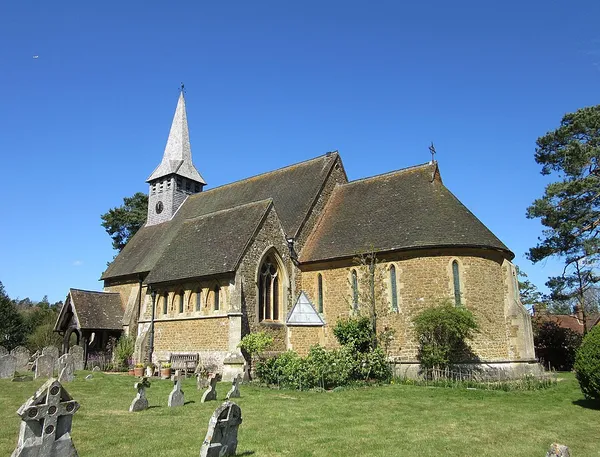
As of 2022, there are more than 110 current and former places of worship in the borough of Waverley in Surrey, England. Various Christian denominations own and use 89 churches, chapels and halls across the borough, and a further 26 buildings no longer serve a religious function but survive in alternative uses. Waverley is the largest of 11 local government districts in the county of Surrey—a small inland county south of London. The borough is largely rural: there are some small towns and dozens of villages and hamlets. Many of these have ancient parish churches, and other places of worship were established in the 18th, 19th and 20th centuries. The 2011 United Kingdom census reported that the majority of residents are Christian. The largest number of churches in Waverley belong to the Church of England—the country's Established Church—but Roman Catholicism and Protestant Nonconformism are also well represented, the latter particularly in the ancient towns of Farnham and Godalming. Congregationalist churches can be traced back to the 17th century in the borough, Unitarianism and the Religious Society of Friends (Quakers) have a long history in Godalming, and Methodists and Baptists each have several congregations. Other denominations and groups represented in the borough include Christian Scientists, Jehovah's Witnesses, the Assemblies of God and the Plymouth Brethren Christian Church. Historic England has awarded listed status to 38 current and seven former places of worship in Waverley borough. A building is defined as "listed" when it is placed on a statutory register of buildings of "special architectural or historic interest" in accordance with the Planning (Listed Buildings and Conservation Areas) Act 1990. The Department for Culture, Media and Sport, a Government department, is responsible for this; Historic England, a non-departmental public body, acts as an agency of the department to administer the process and advise the department on relevant issues. There are three grades of listing status. Grade I, the highest, is defined as being of "exceptional interest"; Grade II* is used for "particularly important buildings of more than special interest"; and Grade II, the lowest, is used for buildings of "special interest".
Also on this shelf
Carolingian Renaissance.
Book of Mulling.
See also
Uncatalogued shelfText from Wikipedia; plate via Wikimedia Commons. Text CC BY-SA 4.0; plate freely licensed (see Commons). Source record. Images and catalogue data are reproduced from open-access collections.