Medieval and Manuscripts
Bayeux Tapestry
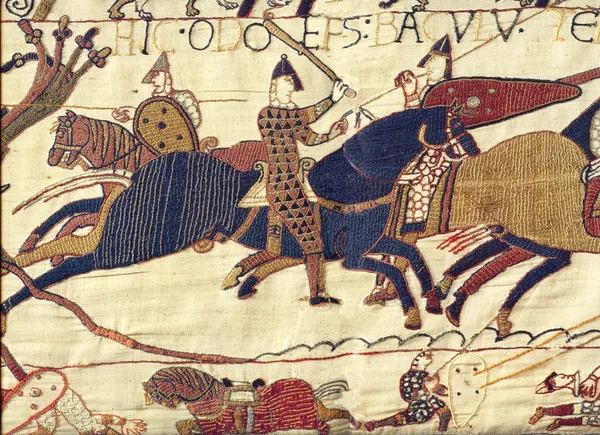
The Bayeux Tapestry (French: Tapisserie de Bayeux) is an embroidered cloth nearly 70 metres (230 feet) long and 50 centimetres (20 inches) tall that depicts the events leading up to the Norman conquest of England, led by William, Duke of Normandy, and the Battle of Hastings in 1066. It is normally thought to have been made in England in the decades after the events it shows, although the earliest known written reference to it was in 1476. Since 2007 it has been inscribed on UNESCO's Memory of the World Register. It is normally displayed in the Bayeux Tapestry Museum in Bayeux, Normandy, France, but this is closed for renovation until 2027, and the work is currently on display in London. Despite its name, the work is technically an embroidery rather than a true tapestry, since the images are stitched rather than woven into the fabric. It was worked in wool thread on a coarse linen ground using four different stitches and ten natural dye colours. The cloth now consists of 58 scenes, all with Medieval Latin tituli. The surviving piece depicts 623 human figures, 994 animals, 438 plants, 37 buildings and fortifications, 41 ships and boats, and a vast array of other objects. The narrative runs from the final years of the reign of Edward the Confessor in 1064 through to the Battle of Hastings in 1066, when William, Duke of Normandy, defeated Harold Godwinson to claim the English throne. The final scenes are missing. The tapestry gives a detailed account of the battle's key turning points, though nearly half of its scenes actually cover events that preceded the invasion itself. It is generally thought to have been commissioned by Bishop Odo of Bayeux, William's half-brother who appears four times, and produced in England in the years following the Conquest. Although it presents the Conquest from a viewpoint highly favourable to William, leading some historians to read it as propaganda meant to legitimise his rule and win over the Anglo-Saxon nobility, the tapestry remains an invaluable historical source on 11th-century life in the Duchy of Normandy and England, documenting clothing, castles, ships and everyday customs of the period.
Also on this shelf
Basilica of Our Lady of Geneva.
Béthanie (Hong Kong).
See also
Uncatalogued shelfText from Wikipedia; plate via Wikimedia Commons. Text CC BY-SA 4.0; plate freely licensed (see Commons). Source record. Images and catalogue data are reproduced from open-access collections.