Medieval and Manuscripts
Depictions of Muhammad
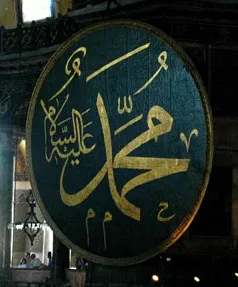
The permissibility of depictions of Muhammad in Islam has been a contentious issue. Oral and written descriptions of Muhammad are readily accepted by all traditions of Islam, but there is disagreement about visual depictions. The Quran does not place any explicit or implicit prohibition on images of Muhammad. The hadith (supplemental teachings) present an ambiguous picture, but there are a few that have prohibited Muslims from creating visual depictions of human figures. It is agreed on all sides that there is no authentic visual tradition (pictures created during Muhammad's lifetime) as to the appearance of Muhammad, although there are early legends of portraits of him, and written physical descriptions whose authenticity is often accepted. The question of whether images in Islamic art, including those depicting Muhammad, can be considered as religious art remains a matter of contention among scholars. They appear in illustrated books that are normally works of history or poetry, including those with religious subjects; the Quran is never illustrated: "context and intent are essential to understanding Islamic pictorial art. The Muslim artists who created images of Muhammad, as well as the public who viewed them, understood that these images were not intended as objects of worship. Nor were the objects so decorated used as part of religious worship". However, scholars concede that such images have "a spiritual element", and were also sometimes used in informal religious devotions celebrating the day of the Mi'raj. Many visual depictions only show Muhammad with his face veiled, or symbolically represent him as a flame; other images, notably from before about 1500, show his face. With the notable exception of modern-day Iran, depictions of Muhammad were never numerous in any community or era throughout Islamic history, and appeared almost exclusively in the private medium of Persian and other miniature book illustration. The key medium of public religious art in Islam was and is calligraphy. In Ottoman Turkey the hilya developed as a decorated visual arrangement of texts about Muhammad that was displayed as a portrait might be. Visual depictions of Muhammad have always been rare in the non-Islamic West. In the Middle Ages they were mostly hostile, and most often appear in illustrations of Dante's poetry.
Also on this shelf
Agapemonites.
Giant bible.
See also
Uncatalogued shelfText from Wikipedia; plate via Wikimedia Commons. Text CC BY-SA 4.0; plate freely licensed (see Commons). Source record. Images and catalogue data are reproduced from open-access collections.