Medieval and Manuscripts
Attributed arms
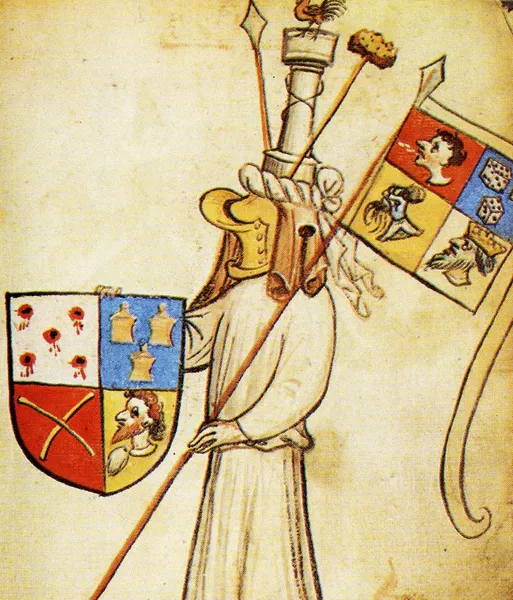
Attributed arms are Western European coats of arms given retrospectively to persons real or fictitious who died before the start of the age of heraldry in the latter half of the 12th century. Once coats of arms were the established fashion of the ruling class, society expected a king to be armigerous. Arms were assigned to the knights of the Round Table, and then to biblical figures, to Roman and Greek heroes, and to kings and popes who had not historically borne arms. Individual authors often attributed different arms for the same person, although the arms for major figures eventually became fixed. Notable arms attributed to biblical figures include the arms of Jesus based on the instruments of the Passion, and the shield of the Trinity. Medieval literature attributed coats of arms to the Nine Worthies, including Alexander the Great, Julius Caesar, and King Arthur. Arms were given to many kings predating heraldry, including Edward the Confessor and William I of England. These attributed arms were sometimes used in practice as quarterings in the arms of their descendants.
Also on this shelf
Bartolini Salimbeni Chapel.
Christ Pantocrator (Sinai).
See also
Uncatalogued shelfText from Wikipedia; plate via Wikimedia Commons. Text CC BY-SA 4.0; plate freely licensed (see Commons). Source record. Images and catalogue data are reproduced from open-access collections.