Medieval and Manuscripts
Clergy
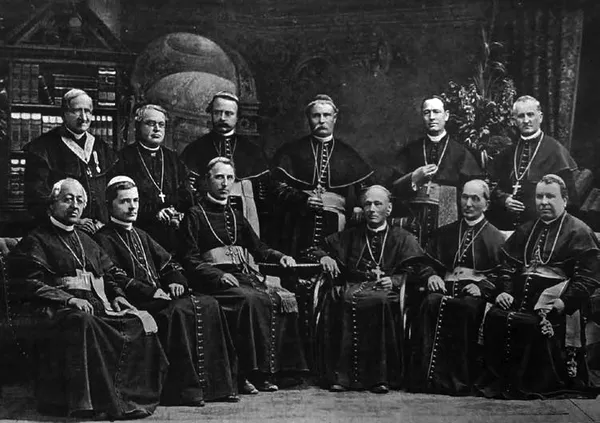
Clergy are leaders within established religions. Their roles and functions vary in different religious traditions, but usually involve presiding over specific rituals and teaching their religion's doctrines and practices. Some of the terms used for individual clergy are clergyman, clergywoman, clergyperson, churchman, cleric, ecclesiastic, and vicegerent while clerk in holy orders has a long history but is rarely used. In Christianity, the specific names and roles of the clergy vary by denomination and there is a wide range of formal and informal clergy positions, including deacons, elders, priests, bishops, cardinals, preachers, pastors, presbyters, ministers, and the pope. In Islam, a religious leader is often formally or informally known as an imam, caliph, qadi, mufti, sheikh, mullah, muezzin, or an ulema. In the Jewish tradition, a religious leader is often a rabbi (teacher) or hazzan (cantor).
Also on this shelf
Church of St John the Divine, Morecambe.
All Saints Church, Highbrook.
See also
- ▸Grace Episcopal Cathedral (Topeka, Kansas)
- ▸Caprotti valve gear
- ▸Church of the Holy Sepulchre, Auckland
Text from Wikipedia; plate via Wikimedia Commons. Text CC BY-SA 4.0; plate freely licensed (see Commons). Source record. Images and catalogue data are reproduced from open-access collections.