Medieval and Manuscripts
Christendom
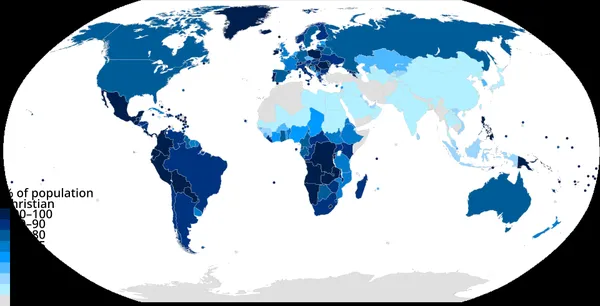
Christendom or the Christian world are terms commonly used to refer to the global Christian community, Christian states, Christian-majority countries or countries in which Christianity is dominant or prevails. Following the spread of Christianity from the Levant to Europe and North Africa during the early Roman Empire, Christendom has been divided in the pre-existing Greek East and Latin West. After the Great schism of 1054, two main branches within Christianity emerged, centred around the cities of Rome (Western Christianity, whose community was called Western or Latin Christendom) and Constantinople (Eastern Christianity, whose community was called Eastern Christendom or Byzantine commonwealth). After the fall of Constantinople in 1453, Latin Christendom rose to a central role in the Western world. Following the Reformation, Protestantism emerged as the third main branch of Christianity in the 16th century. The history of the Christian world spans about 2,000 years and includes a variety of socio-political developments, as well as advancements in the arts, architecture, literature, science, philosophy, politics and technology.
Also on this shelf
Basilica of St. Mary (Alexandria, Virginia).
Cathedral of Saint John the Baptist (Charleston, South Carolina).
See also
- ▸Crosses in heraldry
- ▸2012 United States presidential election in South Carolina
- ▸Fourth Presbyterian Church (Chicago)
Text from Wikipedia; plate via Wikimedia Commons. Text CC BY-SA 4.0; plate freely licensed (see Commons). Source record. Images and catalogue data are reproduced from open-access collections.