Medieval and Manuscripts
France in the Middle Ages
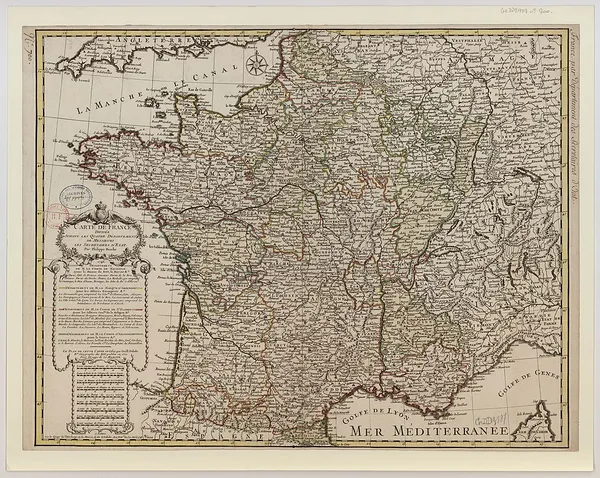
The Kingdom of France was a decentralised, feudal monarchy in the Middle Ages (c. 10th–mid-15th century). In Brittany, Normandy, Lorraine, Provence, East Burgundy and Catalonia (the latter now a part of Spain), as well as Aquitaine, the authority of the French king was barely felt. France evolved from the fragmentation of West Francia () to the gradual centralisation of power under the House of Capet (987–1328). This period saw royal struggles with semi-independent principalities like Normandy and Anjou, as well as administrative expansion – especially under Philip II Augustus and Louis IX. The House of Valois (1328–1589) then faced the House of Plantagenet and their Angevin Empire in the Hundred Years' War (1337–1453), a conflict exacerbated by the Black Death (1348). These events fostered a more centralised state and a nascent French identity by the early modern period. Up to the 12th century, the territory experienced an elaboration and extension of the seigneurial economic system (including the attachment of peasants to the land through serfdom); the extension of the feudal system of political rights and obligations between lords and vassals; the so-called "feudal revolution" of the 11th century, during which ever smaller lords took control of local lands in many regions; and the appropriation by regional/local seigneurs of various administrative, fiscal and judicial rights for themselves. From the 13th century on, the state slowly regained control of a number of these lost powers. The crises of the 13th and 14th centuries led to the convening of an advisory assembly, the Estates General, and an effective end to serfdom.
Also on this shelf
Arbor Hill Historic District–Ten Broeck Triangle.
Forest Park Southeast Historic District.
See also
Uncatalogued shelfText from Wikipedia; plate via Wikimedia Commons. Text CC BY-SA 4.0; plate freely licensed (see Commons). Source record. Images and catalogue data are reproduced from open-access collections.