Medieval and Manuscripts
Cheetah
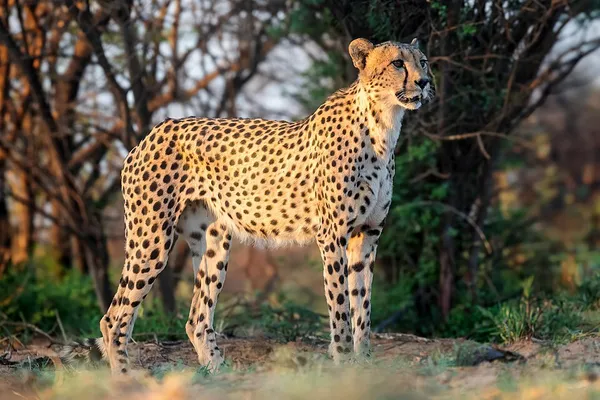
The cheetah (Acinonyx jubatus) is a species of large feline and the only living member of the genus Acinonyx. The cheetah is a pursuit predator and the fastest land animal, capable of running at 93–104 km/h (58–65 mph); it has evolved for speed, having powerful hindlimb muscles and a long lumbar spine. The cheetah has a tawny to creamy white or pale buff fur that is marked with evenly spaced, solid black spots. The head is small and rounded, with a short snout and black tear-like facial streaks. It has a height of 67–94 cm (2.20–3.08 ft) at the shoulder, and the head-and-body length is between 1.1 and 1.5 m (3 ft 7 in and 4 ft 11 in). Adults weigh between 21 and 65 kg (46 and 143 lb). The cheetah was first scientifically described in the late 18th century. Four subspecies are recognised today that are native to Africa and central Iran. An African subspecies was introduced to India in 2022. It is now distributed mainly in small, fragmented populations in northwestern, eastern and southern Africa and central Iran. It lives in a variety of habitats such as savannahs in the Serengeti, arid mountain ranges in the Sahara, and hilly desert terrain. The cheetah lives in three main social groups: females and their cubs, male "coalitions", and solitary males. While females lead a nomadic life searching for prey in large home ranges, males are more sedentary and instead establish much smaller territories in areas with plentiful prey and access to females. The cheetah is active during the day, with peaks during dawn and dusk. It feeds on small- to medium-sized prey, mostly weighing under 40 kg (88 lb), and prefers medium-sized ungulates such as impala, springbok and Thomson's gazelles. The cheetah typically stalks and approaches its prey within 30–200 m (98–656 ft) before charging at high speed, striking down the prey with its dewclaw in full pursuit and killing it with a throat bite. It breeds throughout the year. After a gestation of nearly three months, females give birth to a litter of three or four cubs, who are weaned at around four months and are independent by around 20 months of age. Cheetah cubs are highly vulnerable to predation by other large carnivores such as lions and hyenas, who also routinely steal kills from adult cheetahs. The cheetah is threatened by habitat loss, conflict with humans, poaching and high susceptibility to diseases.
Also on this shelf
Flying buttress.
Bromyard.
See also
Uncatalogued shelfText from Wikipedia; plate via Wikimedia Commons. Text CC BY-SA 4.0; plate freely licensed (see Commons). Source record. Images and catalogue data are reproduced from open-access collections.