Medieval and Manuscripts
Ciborium (architecture)
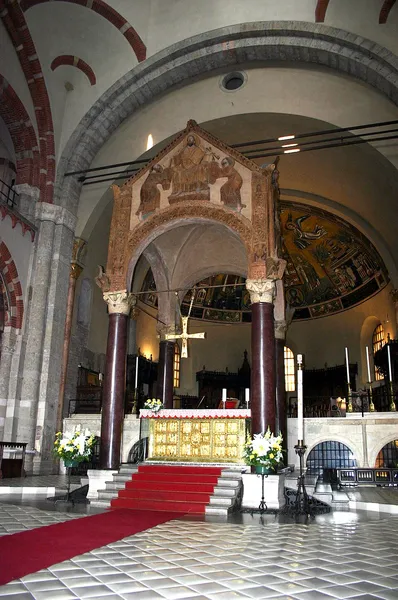
In ecclesiastical architecture, a ciborium (Greek: κιβώριον; lit. 'ciborion') is a canopy or covering supported by columns, freestanding in the sanctuary, that stands over and covers the altar in a church. It may also be known by the more general term of baldachin, though ciborium is often considered more correct for examples in churches. A baldachin (originally an exotic type of silk from Baghdad) should have a textile covering, or, as at St. Peter’s Basilica in Vatican City, imitate one. There are exceptions; St. Peter's Baldachin, Bernini's structure in Saint Peter's Basilica, is always called the baldachin. Early ciboria had curtains hanging from rods between the columns, so that the altar could be concealed from the congregation at points in the liturgy. Smaller examples may cover other objects in a church. In a very large church, a ciborium is an effective way of visually highlighting the altar, and emphasizing its importance. The altar and ciborium are often set upon a dais to raise it above the floor of the sanctuary. A ciborium is also a covered, chalice-shaped container for Eucharistic hosts. In Italian the word is often used for the tabernacle on the altar, which is not the case in English.
Also on this shelf
Holy Name Church (West Roxbury, Massachusetts).
Bamberg State Library.
See also
Uncatalogued shelfText from Wikipedia; plate via Wikimedia Commons. Text CC BY-SA 4.0; plate freely licensed (see Commons). Source record. Images and catalogue data are reproduced from open-access collections.