Medieval and Manuscripts
Church of the Holy Sepulchre
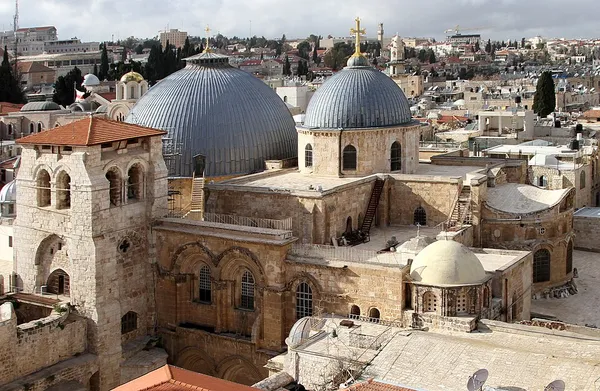
The Church of the Holy Sepulchre, also known as the Church of the Resurrection, is a fourth-century church in the Christian Quarter of the Old City of Jerusalem. The church is simultaneously the seat of the Armenian Patriarchate of Jerusalem, Greek Orthodox Patriarchate of Jerusalem, and the Catholic Latin Patriarchate of Jerusalem. It is the holiest site in Christianity, and it has been an important pilgrimage site for Christians since the fourth century. According to traditional beliefs dating to the fourth century, the church contains the site of the Crucifixion of Jesus at Calvary, or Golgotha, and the location of Jesus's empty tomb where he was buried and resurrected. Both locations are considered immensely holy sites by most Christians. Scholars note that there are two or three independent accounts of the burial of Jesus in a tomb, and archeologists are in general agreement that this is likely the location. The Gospel of John and archaeological finds show at least seven corroborations in mundane details with the Church of the Holy Sepulchre. After the crucifixion Emperor Hadrian covered the tomb of Jesus and erected a Temple of Aphrodite on top of it (ca. 135 AD), where it remained until Constantine rediscovered the tomb around 325 AD. The church and rotunda were built under Constantine the Great in the 4th century, confirmed by scientific testing, and destroyed in 1009 by al-Hakim. Al-Hakim's son allowed Emperor Constantine IX Monomachos to reconstruct the church, which was completed in 1048. After it was captured by the crusaders in 1099, it continued to undergo modifications, resulting in a significant departure from the original structure. Several renovations and restorations were made under the Ottomans. The tomb itself is enclosed by a 19th-century shrine called the Aedicule. Within the church proper are the last four stations of the Cross of the Via Dolorosa, representing the final episodes of the Passion of Jesus. Since its creation the church has been a major Christian pilgrimage destination as the traditional site of the resurrection of Christ, thus its original Greek name, Church of the Anastasis (Resurrection). The Status Quo, an understanding between religious communities dating to 1757, applies to the site.
Also on this shelf
Champmol.
Church of the Holy Spirit, Heidelberg.
See also
Uncatalogued shelfText from Wikipedia; plate via Wikimedia Commons. Text CC BY-SA 4.0; plate freely licensed (see Commons). Source record. Images and catalogue data are reproduced from open-access collections.