Medieval and Manuscripts
Carolingian cross
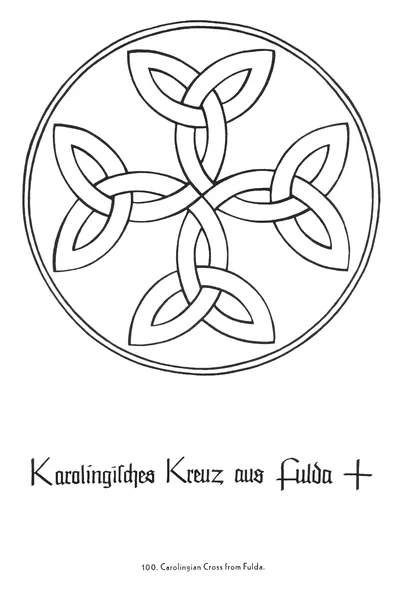
The Carolingian Cross is but one variation in the vast historical imagery of Christian symbolic representations of the Crucifixion of Jesus, going back to at least the ninth century. All crosses and Christian symbols have an inherent meaning arising from a multitude of sources and distinct features that set them apart from other religions. From both a design aspect and a theological perspective, the Carolingian Cross consists of a mixture of Christian and pre-Christian concepts built over a long history of cultural adaptation, religious iconography, liturgical practices and theological premises. German graphic designer Rudolf Koch in 1932 published a collection of 158 plates of drawings of Christian symbols. Under the heading of "Cross", this includes twelve drawings of Christian cross variants. One of these, the "Carolingian Cross" (Karolingisches Kreuz) shows a cross of four triquetras.
Also on this shelf
Dering Roll.
Cathedral of St. Andrew (Little Rock, Arkansas).
See also
Uncatalogued shelfText from Wikipedia; plate via Wikimedia Commons. Text CC BY-SA 4.0; plate freely licensed (see Commons). Source record. Images and catalogue data are reproduced from open-access collections.