Medieval and Manuscripts
Almohad Caliphate
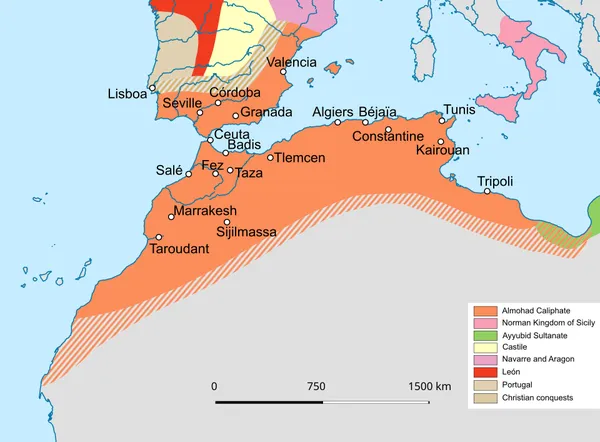
The Almohad Caliphate or Almohad Empire was a North African Muslim empire ruled by a Berber dynasty from 1130 to 1269 (AH 524–667), which at its height controlled much of the Maghreb and the Iberian Peninsula (Al-Andalus). The Spanish name "Almohads" derives from the Arabic al-Muwaḥḥidūn, "those who espouse Oneness", reflecting the dynasty's emphasis on divine unity and its protest against what it regarded as the lax character of prevailing Islam, particularly under the Almoravids. The Almohad movement originated among the Masmuda Berbers under Ibn Tumart, who supplied its religious and ideological inspiration and was recognized by his followers as the Mahdi around 1121. He subsequently established a base at Tinmel in the Atlas Mountains. After Ibn Tumart's death, his successor Abd al-Mu'min founded the Almohad caliphate and its ruling Mu'minid dynasty and transformed the movement into a major territorial power. Under Abd al-Mu'min (r. 1130–1163), the Almohads overthrew the Almoravids, captured Marrakesh in 1147, and established control over the western Maghreb. Abd al-Mu'min declared himself caliph. Their rule was extended across the Maghreb by 1159 and subsequently into Muslim Iberia. Muslim Spain had fallen under their control by about 1170–1172, and Seville served for a time as their principal centre in al-Andalus. The Almohad period was marked by significant developments in philosophy and architecture. Among the major intellectual figures associated with the period were Ibn Ṭufayl, Ibn Rushd, and Ibn ʿArabī. A characteristic architectural form, the "Almohad arch", has been interpreted as a physical expression of the imagery of sūra 94 of the Qurʾān, in which God is described as relieving and expanding the burdened human condition. The former Almohad Great Mosque of Seville, of which the Giralda survives as part of the present cathedral, exemplifies this architectural conception. The decisive turning point of Almohad power in Iberia came in 1212 (AH 609), when caliph Muhammad al-Nasir was defeated at the Battle of Las Navas de Tolosa by an alliance of forces from Castile, Aragon, and Navarre. The defeat initiated a prolonged decline in Almohad power in al-Andalus; Córdoba fell to Christian forces in 1236 and Seville in 1248. In North Africa, revolts by tribes and districts weakened Almohad authority and facilitated the rise of the Marinids from 1215.
Also on this shelf
Estonian Christian Orthodox Church.
History of Armenia.
See also
Uncatalogued shelfText from Wikipedia; plate via Wikimedia Commons. Text CC BY-SA 4.0; plate freely licensed (see Commons). Source record. Images and catalogue data are reproduced from open-access collections.