Medieval and Manuscripts
Ireland
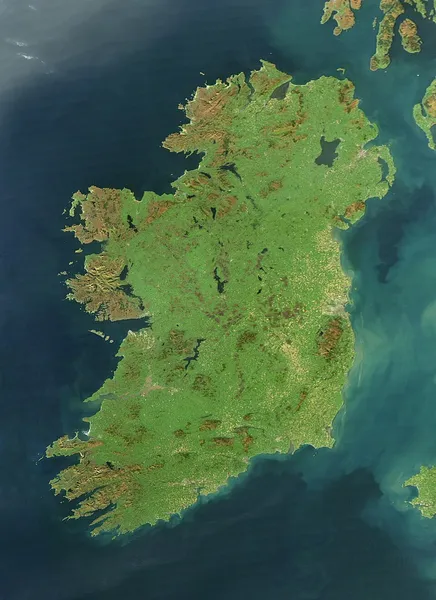
Ireland is an island in the North Atlantic Ocean, in Northwestern Europe. Geopolitically, the island is divided between the Republic of Ireland (officially named Ireland – a sovereign state covering five-sixths of the island) and Northern Ireland (part of the United Kingdom – covering the remaining sixth). It is separated from Great Britain to its east by the North Channel, the Irish Sea, and St George's Channel. Ireland is the second-largest island of the British Isles, the third-largest in Europe, and the twentieth-largest in the world. As of 2022, the population of the entire island is just over 7 million, with 5.1 million in the Republic of Ireland and 1.9 million in Northern Ireland, ranking it the second-most populous island in Europe after Great Britain. The geography of Ireland comprises relatively low-lying mountains surrounding a central plain, with several navigable rivers extending inland. Much of Ireland was woodland until the end of the Middle Ages. Today, woodland makes up about 10% of the island, compared with a European average of over 33%, with most of it being non-native conifer plantations. Its lush vegetation is a product of its mild climate, which is influenced by the Atlantic Ocean and thus very moderate, and winters are milder than expected for such a northerly area, although summers are cooler than those in continental Europe. Rainfall and cloud cover are abundant. Gaelic Ireland had emerged by the 1st century AD. The island was Christianised from the 5th century onwards. During this period Ireland was divided amongst petty kings, who in turn served under the kings of the traditional provinces (Cúige; lit. 'fifth') vying for dominance and the title of High King of Ireland. Between the late 8th and early 11th centuries, Viking raids and settlement took place culminating in the Battle of Clontarf on 23 April 1014 which resulted in the end of Viking power in Ireland. Following the 12th-century Anglo-Norman invasion, England claimed sovereignty. However, English rule did not extend over the whole island until the 16th–17th century Tudor conquest, which led to colonisation by settlers from Britain. In the 1690s, a system of Protestant English rule was designed to materially disadvantage the Catholic majority and Protestant dissenters, and was extended during the 18th century.
Also on this shelf
Abbatial church of Notre-Dame de Mouzon.
Culture of Kievan Rus'.
See also
Uncatalogued shelfText from Wikipedia; plate via Wikimedia Commons. Text CC BY-SA 4.0; plate freely licensed (see Commons). Source record. Images and catalogue data are reproduced from open-access collections.