Medieval and Manuscripts
Chapel-burial vault of Svyatopolk-Mirsky family
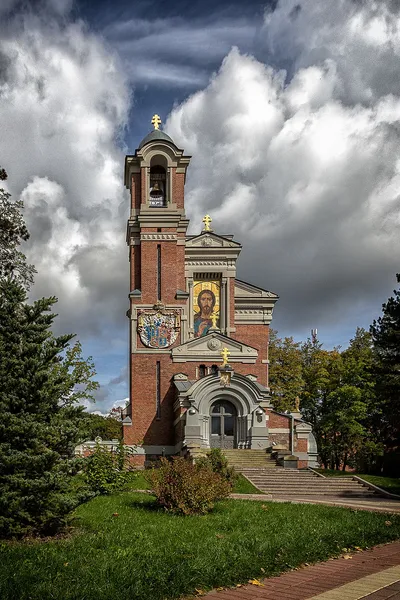
Chapel-burial vault of Svyatopolk-Mirsky family (Russian: Часо́вня-усыпа́льница Святопо́лк-Ми́рских), also known as Spasskaya Chapel, is an architectural monument located in the urban settlement of Mir, Karelichy District, Grodno Region, Belarus, and situated near the Mir Castle within the English-style park, established at the end of the 19th to the beginning of the 20th century. The chapel-tomb was constructed between 1904 and 1910 based on a design by architect Robert Marfeld, funded by Cleopatra Svyatopolk-Mirskaya. It was consecrated in honor of Nicholas the Wonderworker. Over the years, six members of the Svyatopolk-Mirsky family were buried in its crypt. During the period of the Second Polish Republic, thanks to the efforts of Prince Mikhail Svyatopolk-Mirsky, rare coniferous trees and roses were planted around the building. Under Soviet rule, the church's property was looted, with some items transferred to a nearby church. Post-war, the chapel served as a grain storage for a distillery. It fell into disrepair until restoration work began in 2004, completed by December 1, 2008, when the chapel reopened to visitors. In 2014, the first services were held: a memorial service and a Divine Liturgy. Most researchers classify the chapel-tomb as Art Nouveau. Its dynamically asymmetrical composition was innovative for its time. The structure comprises a narthex, chapel hall, apse, and the dominant feature — a tall bell tower. The tomb is both plastically and coloristically rich. Notable elements include the Svyatopolk-Mirsky family cartouche and a large mosaic panel depicting Christ Pantocrator. The latter dominates the chapel's appearance. Internally, the building has two levels: a crypt and a hall for services. The chapel also serves as a minor architectural feature within Mirsky Park. The Svyatopolk-Mirsky Chapel-Tomb is part of the Mir Castle and Park Complex, which was added to the UNESCO World Heritage List in 2000. The mosaic panel is separately listed in the State List of Historical and Cultural Values of the Republic of Belarus.
Also on this shelf
History of the Jews in England (1066–1290).
Fort Belvedere, Surrey.
See also
Uncatalogued shelfText from Wikipedia; plate via Wikimedia Commons. Text CC BY-SA 4.0; plate freely licensed (see Commons). Source record. Images and catalogue data are reproduced from open-access collections.