Medieval and Manuscripts
Carolingian Renaissance
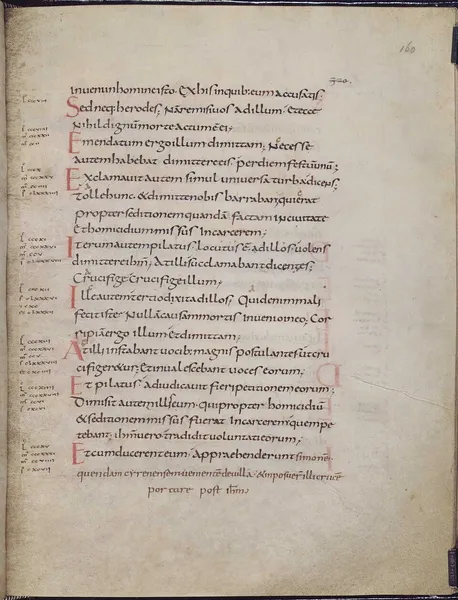
The Carolingian Renaissance was the first of three medieval renaissances, a period of cultural activity in the Carolingian Empire. Charlemagne's reign led to an intellectual revival beginning in the 8th century and continuing throughout the 9th century, taking inspiration from ancient Roman and Greek culture and the Christian Roman Empire of the 4th century. The period saw an increase of literature, writing, visual arts, architecture, music, jurisprudence, liturgical reforms, and scriptural studies. Carolingian schools were effective centers of education, and they served generations of scholars by producing editions and copies of the classics, both Christian and pagan. The movement occurred mostly during the reigns of Carolingian rulers Charlemagne and Louis the Pious. It was supported by the scholars of the court, notably Alcuin of York. Charlemagne's Admonitio generalis (789) and Epistola de litteris colendis served as manifestos. Alcuin wrote on subjects ranging from grammar and biblical exegesis to arithmetic and astronomy. He also collected rare books, which formed the nucleus of the library at York Cathedral. His enthusiasm for learning made him an effective teacher. Alcuin describes himself giving some the honey of the holy scriptures, making others drunk on the old wine of ancient learning, beginning to feed others on the fruits of grammar, while to some I propose to reveal the order of the stars…In the morning, at the height of my powers, I sowed the seed in Britain, now in the evening when my blood is growing cold I am still sowing in France, hoping both will grow, by the grace of God. Another prominent figure was Theodulf of Orléans, a refugee from the Umayyad invasion of Spain who became involved in the cultural circle at the imperial court before Charlemagne appointed him bishop of Orléans. Theodulf's greatest contribution to learning was his scholarly edition of the Vulgate Bible, drawing on manuscripts from Spain, Italy, and Gaul, and even the original Hebrew. The effects of this cultural revival were mostly limited to a small group of court literati. According to John Contreni, "it had a spectacular effect on education and culture in Francia, a debatable effect on artistic endeavors, and an unmeasurable effect on what mattered most to the Carolingians, the moral regeneration of society".
Also on this shelf
Alfred Waterhouse.
Early translations of the New Testament.
See also
Uncatalogued shelfText from Wikipedia; plate via Wikimedia Commons. Text CC BY-SA 4.0; plate freely licensed (see Commons). Source record. Images and catalogue data are reproduced from open-access collections.