Medieval and Manuscripts
Book curse
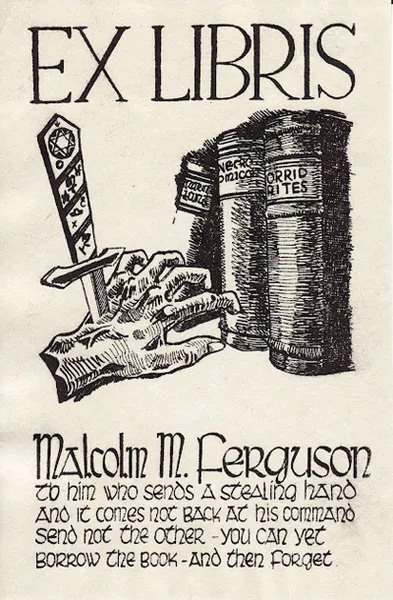
A book curse was a widely employed method to discourage the theft of manuscripts during the medieval period in Europe. The use of book curses dates back much further, to pre-Christian times, when the wrath of gods was invoked to protect books and scrolls. They were often creative and dramatic, usually invoking threat of excommunication, or anathema. Generally located on the first or last page of a volume as part of the colophon, these curses were often considered the only defense in protection of highly coveted books and manuscripts. This was notably a time in which people believed in curses, which was critical to its effect, thus believing that, if a person stole or ripped out a page, they were destined to die an agonizing death. With the introduction of the printing press, these curses instead became "bookplates [which] enabled users to declare ownership through a combination of visual, verbal, and textual resources. For the first time, warning, threatening, and cursing had become multimodal." An example of a book curse is: "If anyone take away this book, let him die the death; let him be fried in a pan; let the falling sickness and fever seize him; let him be broken on the wheel, and hanged. Amen."
Also on this shelf
Eucharist.
Crucifix (Cimabue, Arezzo).
See also
Uncatalogued shelfText from Wikipedia; plate via Wikimedia Commons. Text CC BY-SA 4.0; plate freely licensed (see Commons). Source record. Images and catalogue data are reproduced from open-access collections.