Medieval and Manuscripts
Armenian art
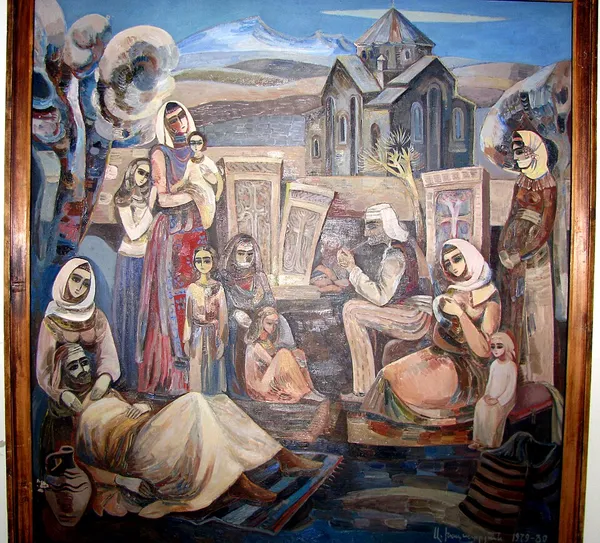
Armenian art is the unique form of art developed over the last five millennia in which the Armenian people lived on the Armenian Highland. Armenian architecture and miniature painting have dominated Armenian art and have shown consistent development over the centuries. Other forms of Armenian art include sculpture, fresco, mosaic, ceramic, metalwork, engraving, and textiles, especially Armenian carpets. Prehistoric Armenia was home to the Urartu culture in the Iron Age, notable for its early metal sculptures, often of animals. The region was, as later, often contested by the large empires holding the nearby regions of Persia, Mesopotamia and Anatolia. The Armenians adopted Christianity very early, and developed their own version of Eastern Christian art, with much use of icons, Armenian miniatures in books, and the very original architecture of their churches and monasteries. A distinctive Armenian feature, which may have influenced the Medieval art of Europe, was the popularity from early on of figurative relief carvings on the outside of churches, unknown in Byzantium. Armenians specialized in arts and crafts such as carpet-weaving.
Also on this shelf
Königsfelden Monastery.
Cathedral of St. Andrew (Little Rock, Arkansas).
See also
Uncatalogued shelfText from Wikipedia; plate via Wikimedia Commons. Text CC BY-SA 4.0; plate freely licensed (see Commons). Source record. Images and catalogue data are reproduced from open-access collections.