Medieval and Manuscripts
Bezant
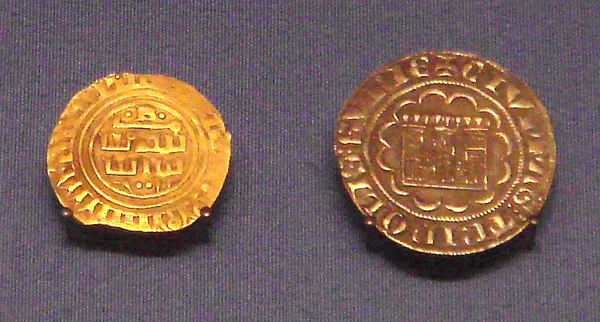
In the Middle Ages, the term bezant (Old French: besant, from Latin bizantius aureus) was used in Western Europe to describe several gold coins of the east, all derived ultimately from the Roman solidus. The word itself comes from the Greek Byzantion, the ancient name of Constantinople, the capital of the Byzantine Empire. The original "bezants" were the gold coins produced by the government of the Byzantine Empire, first the nomisma and from the 11th century the hyperpyron. Later, the term was used to cover the gold dinars produced by Islamic governments. In turn, the gold coins minted in the Kingdom of Jerusalem and County of Tripoli were termed "Saracen bezants" (besantius saracenatus), or "fake dinars" (dīnār ṣūrī), since they were modelled on the Fatimid dinar. A completely different electrum coin based on Byzantine trachea was minted in the Kingdom of Cyprus and called the "white bezant". The term bezant in reference to coins is common in sources from the 10th through 13th centuries. Thereafter, it was mainly employed as a money of account and in literary and heraldic contexts.
Also on this shelf
History of the Eastern Orthodox Church under the Ottoman Empire.
Church of St. Nicholas, Brezova.
See also
Uncatalogued shelfText from Wikipedia; plate via Wikimedia Commons. Text CC BY-SA 4.0; plate freely licensed (see Commons). Source record. Images and catalogue data are reproduced from open-access collections.