Medieval and Manuscripts
Armenian Quarter
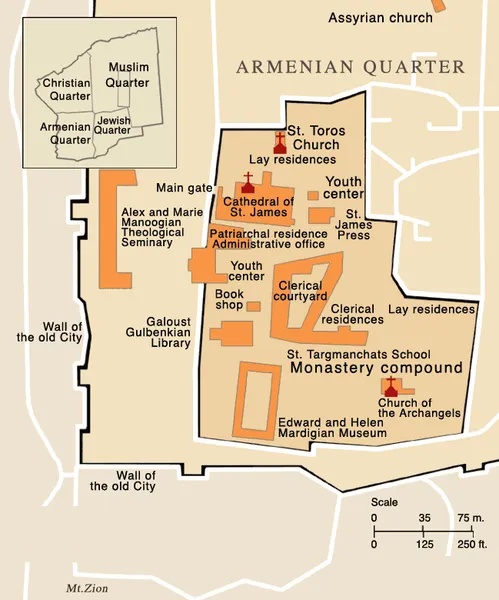
The Armenian Quarter (Armenian: Հայոց թաղ, romanized: Hayots t'agh; Arabic: حارة الأرمن, romanized: Ḥāraṫ al-Arman; Hebrew: הרובע הארמני, romanized: Ha-Rova ha-Armeni) is one of the four sectors of the walled Old City of Jerusalem. Located in the southwestern corner of the Old City, it can be accessed through the Zion Gate and Jaffa Gate. It occupies an area of 0.126 km2 (126 dunam), which is 14% of the Old City's total. In 2007, it had a population of 2,424 (6.55% of Old City's total). In both criteria, it is comparable to the Jewish Quarter. The Armenian Quarter is separated from the Christian Quarter by David Street (Suq el-Bazaar) and from the Jewish Quarter by Habad Street (Suq el-Husur). The Armenian presence in Jerusalem dates back to the 4th century CE, when Armenia adopted Christianity as a national religion and Armenian monks settled in Jerusalem. Hence, it is considered the oldest living diaspora community outside the Armenian homeland. Gradually, the quarter developed around the St. James Monastery—which dominates the quarter—and took its modern shape by the 19th century. The monastery houses the Armenian Apostolic Church's Jerusalem Patriarchate, which was established as a diocese in the 7th century CE. The patriarchate is the de facto administrator of the quarter and acts as a "mini-welfare state" for the approximately 2,000 Armenian residents. Though institutionally separate from the Greek Orthodox and Catholic Christians, the Armenians consider their quarter to be part of the Christian Quarter. The three Christian patriarchates of Jerusalem and the government of Armenia have publicly expressed their opposition to any political division of the two quarters. The quarter is perceived as separate from the rest of the Christian Quarter because of its distinct Armenian language and culture. However, after several generations of living with Palestinians, there are many Armenians who identify as both Armenian and Palestinian, and especially those whose ancestors had already lived in Palestine centuries prior to Armenian genocide, are well integrated into the Arabic cultural and linguistic milieu.
Also on this shelf
Church of the Nativity.
Bury St Edmunds.
See also
Uncatalogued shelfText from Wikipedia; plate via Wikimedia Commons. Text CC BY-SA 4.0; plate freely licensed (see Commons). Source record. Images and catalogue data are reproduced from open-access collections.