Medieval and Manuscripts
Halo (religious iconography)
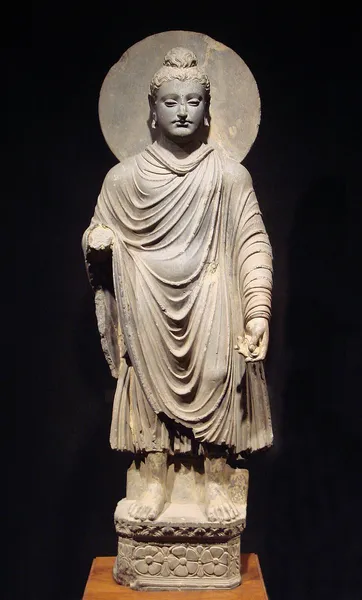
A halo (from Ancient Greek ἅλως, hálōs, 'threshing floor, disk'), also called a nimbus, aureole, glory or gloriole (Latin: gloriola, lit. 'little glory'), is a crown of light rays, circle or disk of light that surrounds a person in works of art. The halo occurs in the iconography of many religions to indicate holy or sacred figures, and has at various periods also been used in images of rulers and heroes. In the religious art of Ancient Greece, Ancient Rome, Christianity, Hinduism, and Buddhism (among other religions), sacred people may be depicted with a halo in the form of a circular glow, or flames in Asian art, around the head or around the whole body—this last form is often called a mandorla. Halos may be shown as almost any colour or combination of colours, but are most often depicted as golden, yellow or white (when representing light) or as red (when representing flames). The earliest artistic depictions of halos were probably in Ancient Egyptian art.
Also on this shelf
St Andrew's Presbyterian Church, Dunedin.
History of flags.
See also
Uncatalogued shelfText from Wikipedia; plate via Wikimedia Commons. Text CC BY-SA 4.0; plate freely licensed (see Commons). Source record. Images and catalogue data are reproduced from open-access collections.