Medieval and Manuscripts
Coat of arms of Denmark
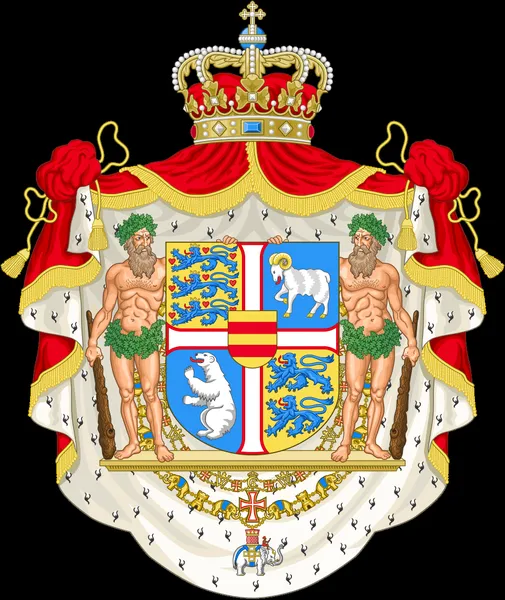
The coat of arms of the Danish Realm (Danish: Danmarks rigsvåben) has a lesser and a greater version. The state coat of arms of Denmark (rigsvåben) consists of three pale blue lions passant wearing crowns, accompanied by nine red lilypads (normally represented as heraldic hearts), all in a golden shield with the royal crown on top. The national coat of arms of Denmark (nationalvåben, also called lille våben) is similar to the state coat of arms, but without the royal crown above the shield. It is evolved from the coat of arms of the House of Estridsen, the dynasty which provided the kings of Denmark between 1047 and 1412. Historically, there had been no distinction between the "national" and the "royal" coat of arms. Since 1819, there has been a more complex royal coat of arms of Denmark (kongevåben) separate from the national coat of arms (rigsvåben). The current design was introduced in 2024, under Frederik X.
Also on this shelf
Angel.
Cultural depictions of Alexander the Great.
See also
Uncatalogued shelfText from Wikipedia; plate via Wikimedia Commons. Text CC BY-SA 4.0; plate freely licensed (see Commons). Source record. Images and catalogue data are reproduced from open-access collections.