Medieval and Manuscripts
Christian prayer
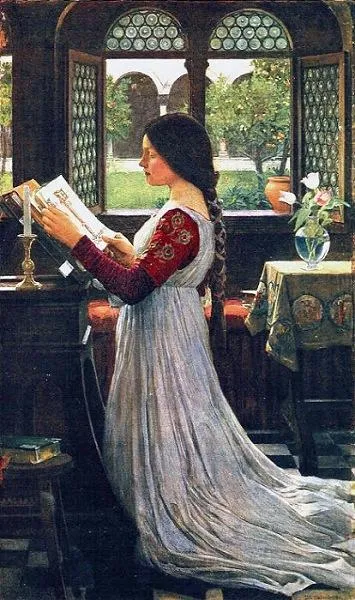
Christian prayer is an important activity in Christian piety, with several different forms. Prayers may be spontaneous or read from written texts such as a breviary, which contains the canonical hours observed at fixed times. Common prayer gestures include folding hands, bowing the head, kneeling, and prostration. The most prominent prayer among Christians is the Lord's Prayer, which according to the gospel accounts (e.g. Matthew 6:9-13) is how Jesus taught his disciples to pray. The injunction for Christians to pray the Lord's Prayer thrice daily was given in Didache 8, 2 f., which, in turn, was influenced by the Jewish practice of praying thrice daily found in the Old Testament, specifically in Psalm 55:17, which suggests "evening and morning and at noon", and Daniel 6:10, in which the prophet Daniel prays thrice a day. The early Christians thus came to recite the Lord's Prayer thrice a day at 9 am, 12 pm, and 3 pm, supplanting the former Amidah predominant in the Hebrew tradition; as such, many Lutheran and Anglican churches ring their church bells from belltowers three times a day: in the morning, at noon and in the evening summoning the Christian faithful to recite the Lord’s Prayer. From the time of the Early Church, the practice of seven fixed prayer times has been taught; in Apostolic Tradition, Hippolytus instructed Christians to pray seven times a day "on rising, at the lighting of the evening lamp, at bedtime, at midnight" and "the third, sixth and ninth hours of the day, being hours associated with Christ's Passion." Oriental Orthodox Christians, such as Copts and Indians, use a breviary such as the Agpeya and Shehimo to pray the canonical hours seven times a day at fixed prayer times while facing in the eastward direction, in anticipation of the Second Coming of Jesus; this Christian practice has its roots in Psalm 119:164, in which the prophet David prays to God seven times a day. Church bells enjoin Christians to pray at these hours. Before praying, they wash their hands and face in order to be clean and present their best to God; shoes are removed to acknowledge that one is offering prayer before a holy God. In these Christian denominations, and in many others as well, it is customary for women to wear a Christian headcovering when praying.
Also on this shelf
Charles Dickens.
Book of Judith.
See also
- ▸Church of the Dormition of the Mother of God (Saint Petersburg)
- ▸Chopsticks
- ▸First Council of Nicaea
Text from Wikipedia; plate via Wikimedia Commons. Text CC BY-SA 4.0; plate freely licensed (see Commons). Source record. Images and catalogue data are reproduced from open-access collections.