Medieval and Manuscripts
Gilles de Rais
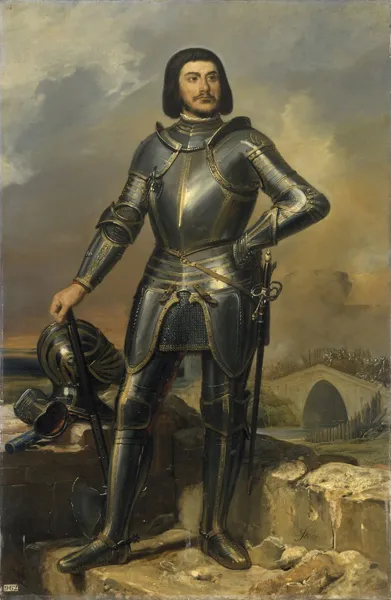
Gilles de Rais, Baron de Rais (French: [ʒil də ʁɛ]; also spelled "Retz"; c. 1405 – 26 October 1440) was a French knight and lord whose estates extended across Brittany, Anjou and Poitou. He served as one of the captains of the French royal army during the Hundred Years' War and took part in the same campaigns as Joan of Arc in 1429, ending with the failed siege of Paris. Little is known about the nature of his relationship with Joan of Arc, despite fictional portrayals that depict them as close companions. He is best known for his conviction for the rape and murder of numerous children. As heir to several major noble houses of western France, Gilles de Rais became a powerful lord and supported Charles VII. In April 1429, he entered into an alliance with his cousin Georges de La Trémoille, the Grand Chamberlain of France. Later that year, he was appointed Marshal of France. He gradually withdrew from military affairs during the 1430s. His family accused him of squandering his inheritance through extravagant spending, and in July 1435 Charles VII placed his lands under royal interdict. In May 1440, Gilles de Rais assaulted a senior cleric at the church of Saint-Étienne-de-Mer-Morte and seized the neighbouring castle, violating ecclesiastical immunity and defying his overlord, John V, Duke of Brittany. Arrested in September, he was tried the following month before both ducal and ecclesiastical courts on charges of heresy, sodomy and the murder of numerous children. He was executed on 26 October 1440. Since the early 19th century, Gilles de Rais has often been associated with the fairy-tale character Bluebeard, although the hypothesis that his life inspired Charles Perrault's 1697 tale remains speculative. From the late 19th century onward, his case has been reinterpreted through successive criminological and psychiatric approaches, including sexual sadism and serial murder. Some scholars caution against applying modern diagnostic categories to a 15th-century figure. Although the validity of his conviction has occasionally been questioned, most professional historians reject claims of his innocence. The detailed witness testimony concerning missing children continues to be regarded as significant, while some of his servants' confessions, though reinterpreted in light of inquisitorial procedure, have no parallel in inquisitorial testimony.
Also on this shelf
Interior architecture.
Cathedral of St Eunan and St Columba.
See also
Uncatalogued shelfText from Wikipedia; plate via Wikimedia Commons. Text CC BY-SA 4.0; plate freely licensed (see Commons). Source record. Images and catalogue data are reproduced from open-access collections.