Medieval and Manuscripts
Geghard
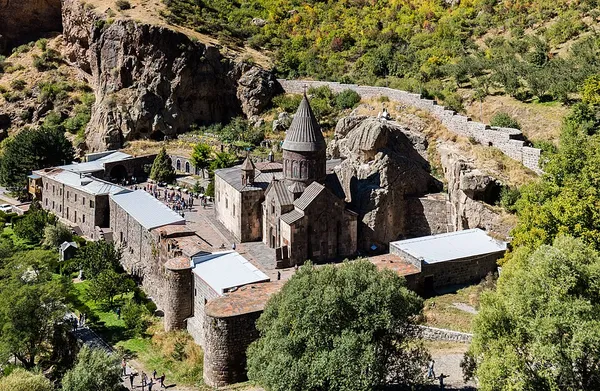
Geghard (Armenian: Գեղարդ, meaning "spear") is a medieval monastery in the Kotayk province of Armenia, which is partially carved out of the adjacent mountain, surrounded by cliffs. It is listed as a UNESCO World Heritage Site with enhanced protection status. While the main chapel was built in 1215, the monastery complex was founded in the 4th century by Gregory the Illuminator at the site of a sacred spring inside a cave. The monastery had thus been originally named Ayrivank (Այրիվանք), meaning "the Monastery of the Cave". The name commonly used for the monastery today, Geghard, or more fully Geghardavank (Գեղարդավանք), meaning "the Monastery of the Spear", originates from the spear which had wounded Jesus at the Crucifixion, allegedly brought to Armenia by Apostle Jude, called here Thaddeus, and stored amongst many other relics. Now it is displayed in the Echmiadzin treasury. The towering cliffs surrounding the monastery are part of the Azat River gorge, and are included together with the monastery in the World Heritage Site listing. Some of the churches within the monastery complex are entirely dug out of the cliff rocks, others are little more than caves, while others are elaborate structures, with both architecturally complex walled sections and rooms deep inside the cliff. There are numerous engraved and free-standing khachkars. The monastery is one of the most frequented tourist destinations in Armenia. Most visitors to Geghard also choose to visit the nearby pagan Temple of Garni, located further down the Azat River. Visiting both sites in one trip is so common that they are often referred to in unison as Garni-Geghard.
Also on this shelf
12th-century Byzantine domes.
Bodø Cathedral.
See also
Uncatalogued shelfText from Wikipedia; plate via Wikimedia Commons. Text CC BY-SA 4.0; plate freely licensed (see Commons). Source record. Images and catalogue data are reproduced from open-access collections.