Medieval and Manuscripts
History of the Church of England
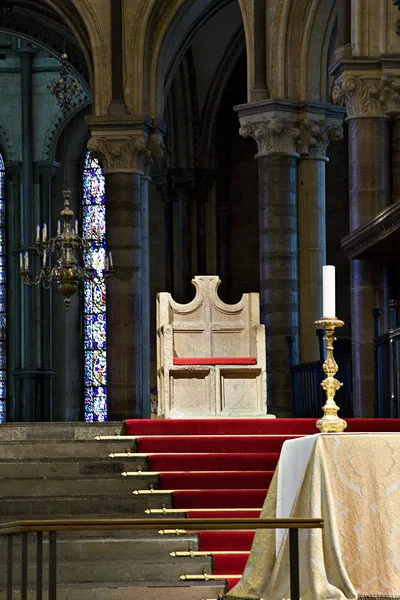
The Church of England claims that its history can be traced back to 597. Specifically, to the Gregorian mission led by Augustine of Canterbury at the behest of Pope Gregory I. This mission instigated the Christianisation of the Anglo-Saxons, and led to Augustine being created the first Archbishop of Canterbury by Gregory. Following from the Gregorian mission, England was under the aegis of Chalcedonian Christianity throughout the Mediaeval Period. During the Great Schism of 1054, England retained its identity within the Catholic Church under the jurisdiction of the Pope. However, the monarchs of England conflicted with the church in England over the amassing of legal privileges and property. Notably, the conflict between Saint Thomas Becket and Henry II over the rights of the church. These conflicts came to a crescendo during the Henrician Reformation, wherein papal authority was abolished in England so that Henry VIII could get an annulment from Catherine of Aragon. Henry VIII had appointed himself Supreme Head of the Church of England. The resulting Act of Supremacy led to a spate of martyrdoms across England, notably Saint Thomas More and Saint John Fisher. Furthermore, monasteries were dissolved and church assets were stolen. Subsequent reformations took place, as part of the wider English Reformation. The Edwardian Reformation oriented the nascent Church of England in a more Reformed Protestant direction during the brief reign of Edward VI (r. 1547–1553). The church was briefly restored to Catholicism during the reign of Mary I (r. 1553–1558), but the Elizabethan Reformation created a more permanent separation during the reign of Elizabeth I (r. 1558–1603). The Elizabethan Religious Settlement established the Church of England as a conservative Reformed Protestant church. During this time, the Book of Common Prayer was authorised as the church's official liturgy and the Thirty-nine Articles as a doctrinal statement. These continue to be important expressions of Anglicanism. The Settlement failed to end religious disputes. While most of the population gradually conformed to the established church, a minority of recusants remained loyal Roman Catholics. Within the Church of England, Puritans pressed to remove what they considered papist abuses from the church's liturgy and to replace bishops with a presbyterian system in which all ministers were equal.
Also on this shelf
Code of Justinian.
Cathedral of the Immaculate Conception (Hangzhou).
See also
Uncatalogued shelfText from Wikipedia; plate via Wikimedia Commons. Text CC BY-SA 4.0; plate freely licensed (see Commons). Source record. Images and catalogue data are reproduced from open-access collections.