Medieval and Manuscripts
Canon (canon law)
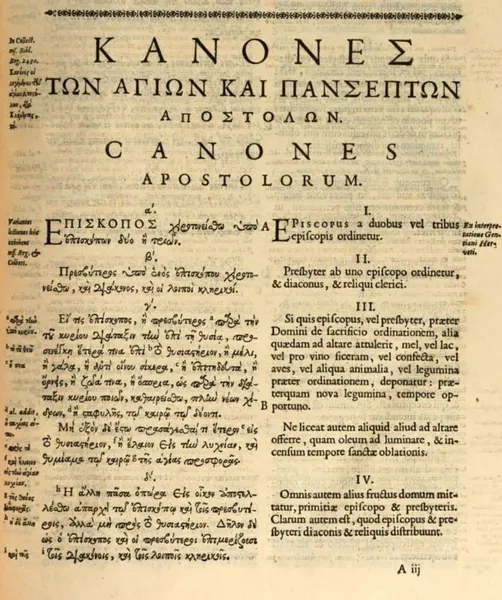
In canon law, a canon designates some law promulgated by a synod, an ecumenical council, or an individual bishop. The word "canon" comes from the Greek kanon, which in its original usage denoted a straight rod that was later the instrument used by architects and artificers as a measuring stick for making straight lines. Kanon eventually came to mean a rule or norm, so that when the first ecumenical council—Nicaea I—was held in 325, kanon started to obtain the restricted juridical denotation of a law promulgated by a synod or ecumenical council, as well as that of an individual bishop.
Also on this shelf
Byzantine Empire under the Amorian dynasty.
Franciscan Friary and the Church of Saint Anthony of Padua, Sarajevo.
See also
Uncatalogued shelfText from Wikipedia; plate via Wikimedia Commons. Text CC BY-SA 4.0; plate freely licensed (see Commons). Source record. Images and catalogue data are reproduced from open-access collections.