Medieval and Manuscripts
Compline
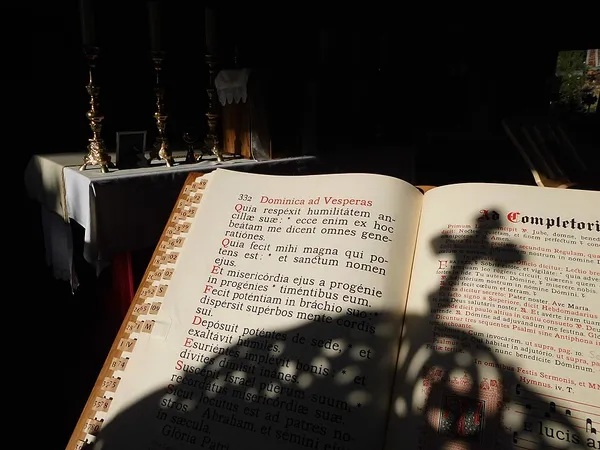
Compline ( KOM-plin), also known as Complin, night prayer, or the prayers at the end of the day, is the final hour or office of the liturgical day in the Christian tradition of the canonical hours. The English word is derived from the Latin completorium, as compline is the completion of the waking day. The word was first used in this sense about the beginning of the 6th century in the Rule of Saint Benedict (Regula Benedicti; hereafter, RB), in Chapters 16, 17, 18, and 42, and he uses the verb compleo to signify compline: "Omnes ergo in unum positi compleant et exeuntes a completorio nulla sit licentia denuo cuiquam loqui aliquid" ("When then all are in their places, let Compline be said; and after coming out from Compline let no one be at liberty to talk to anyone again") (RB, Chap. 42). The Compline is a part of Catholic, Anglican, Lutheran, Oriental Orthodox, Eastern Orthodox, and certain other Christian liturgical traditions. In Western Christianity, Compline tends to be a contemplative office that emphasizes spiritual peace. In most monasteries it is the custom to begin the "Great Silence" after compline, during which the whole community, including guests, observes silence throughout the night until after the Terce the next day. Compline comprises the final office in the Liturgy of the Hours.
Also on this shelf
Elizabeth Seymour, Lady Cromwell.
Attitude (heraldry).
See also
- ▸Immaculate Conception Church (New Orleans)
- ▸David C. Evans (paleontologist)
- ▸Holy Trinity Church (Chicago)
Text from Wikipedia; plate via Wikimedia Commons. Text CC BY-SA 4.0; plate freely licensed (see Commons). Source record. Images and catalogue data are reproduced from open-access collections.