Medieval and Manuscripts
Sculpture in Scotland
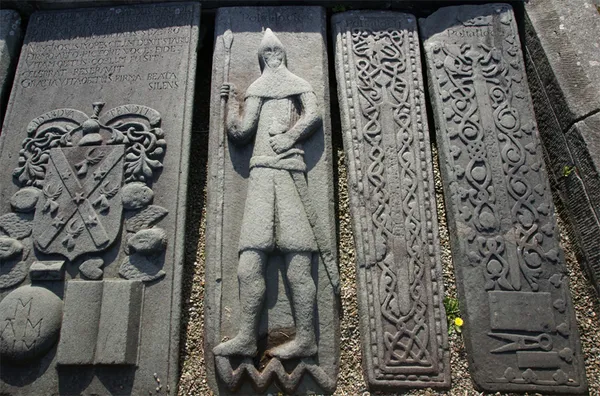
Sculpture in Scotland includes all visual arts operating in three dimensions in the borders of modern Scotland. Durable sculptural processes traditionally include carving (the removal of material) and modelling (the addition of material), in stone, metal, clay, wood and other materials. In the modern era, these were joined by assembly by welding, modelling, moulding and casting. Some installation art can also be considered to be sculpture. The earliest surviving sculptures from Scotland are standing stones and circles from around 3000 BCE. The oldest portable visual art are carved-stone petrospheres, and the Westray Wife is the earliest representation of a human face found in Scotland. From the Bronze Age there are extensive examples of rock art, including cup and ring marks and elaborate carved stone battle-axes. By the early Iron Age, Scotland had been penetrated by the wider European La Tène culture, and a few examples of decoration survive from Scotland. There are also decorated torcs, scabbards, armlets and war trumpets. The Romans began military expeditions into what is now Scotland from about 71 CE, leaving a direct sculptural legacy of distance slabs, altars and other sculptures. Among the most important survivals of Pictish culture are about 250 carved stones. Class I stones are largely unshaped and include incised animals, everyday objects and abstract symbols. Class II stones are carefully shaped slabs dating after the arrival of Christianity in the eighth and ninth centuries, with a cross on one face and a wide range of symbols on the reverse. Class III stones are elaborately shaped and incised cross-slabs, some with figurative scenes. Items of metalwork have been found throughout Pictland. Dál Riata in the west of Scotland was a cross-roads between the artistic styles of the Picts and those of Ireland. There is evidence for the production of high-status jewellery, hanging bowls and other items that indicate that it was one of the locations where the Insular style was developed, which became common across Great Britain and Ireland. The most significant survivals in sculpture in Insular art are high crosses, large free-standing stone crosses, usually carved in relief with patterns, biblical iconography and occasionally, inscriptions.
Also on this shelf
Holy Ascension Church, Upton-by-Chester.
Despot (court title).
See also
Uncatalogued shelfText from Wikipedia; plate via Wikimedia Commons. Text CC BY-SA 4.0; plate freely licensed (see Commons). Source record. Images and catalogue data are reproduced from open-access collections.