Medieval and Manuscripts
Advaita Vedanta
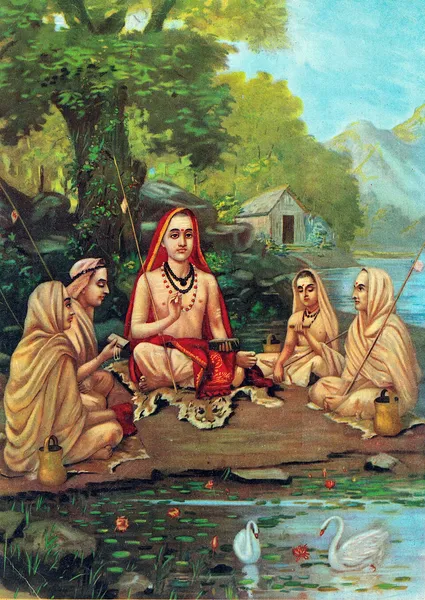
Advaita Vedanta (; Sanskrit: अद्वैतवेदान्तः, IAST: Advaita Vedānta) is a Hindu tradition of Vedanta, a Brahmanical tradition of textual exegesis and philosophy; and a monastic institutional tradition nominally related to the Daśanāmi Sampradaya and propagated by the Smarta tradition. Its core tenet is that jivatman, the individual experiencing self, is ultimately pure awareness mistakenly identified with the body and its senses and with thought-constructs, and non-different from the ultimate reality, Brahman, whose essence is Saccidānanda (Existence-consciousness-bliss). The term Advaita (अद्वैत) literally means "not-two" or "one without a second", which means that only Brahman, 'the one', is ultimately real while prapanca, 'the second', 'the world' or the multiplicity of thought-constructs, is not fully real. It is commonly rendered as "nonduality", and popularly interpreted as meaning that Atman is non-different from Brahman, and often equated with monism. Advaita Vedanta is a Hindu sādhanā, a path of spiritual discipline and experience. It states that moksha ('liberation', freedom) is attained when knowledge of Brahman is attained, recognising the illusoriness of the phenomenal world and disidentifying from body-mind and the notion of 'doership', acquiring vidyā (knowledge) of one's true identity as Atman-Brahman, self-luminous (svayam prakāśa) awareness or Witness-consciousness. This knowledge is revealed through Upanishadic statements such as tat tvam asi, "that['s how] you are", which destroy the ignorance (avidyā) regarding one's true identity by revealing that (jiv)Ātman is non-different from immortal Brahman. The Advaita vedanta tradition modifies the Samkhya-dualism between Purusha (pure awareness or consciousness) and Prakriti ('nature', which includes matter but also cognition and emotion) as the two equal basic principles of existence. It proposes instead that Atman-Brahman (awareness, purusha) alone is ultimately real and, though unchanging, is the cause and origin of the transient phenomenal world (prakriti). In this view, the jivatman or individual self is a mere reflection or limitation of singular Ātman in a multitude of apparent individual bodies.
Also on this shelf
Holy Trinity Cathedral, Sibiu.
Chapel of the Holy Sepulchre.
See also
Uncatalogued shelfText from Wikipedia; plate via Wikimedia Commons. Text CC BY-SA 4.0; plate freely licensed (see Commons). Source record. Images and catalogue data are reproduced from open-access collections.