Medieval and Manuscripts
Braunschweig
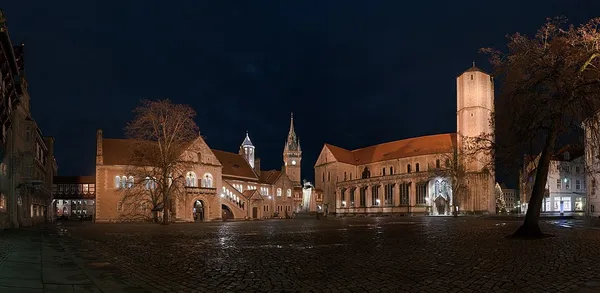
Braunschweig (German: [ˈbʁaʊnʃvaɪk] ) or Brunswick (English: BRUN-zwik; from Low German Brunswiek, local dialect: Bronswiek [ˈbrɔˑnsviːk]) is a city in Lower Saxony, Germany, north of the Harz Mountains at the farthest navigable point of the river Oker, which connects it to the North Sea via the rivers Aller and Weser. In 2025, it had a population of 255,500. The Braunschweig-Wolfsburg-Salzgitter region had 1.02 million residents including the cities Wolfsburg and Salzgitter. It is the second largest urban center in Lower Saxony after Hanover. The urban agglomeration of Braunschweig had a population of 551,000 with over 40% having a migration background, making it the most diverse urban agglomeration in the whole state. The city consists of 42.2% immigrants (approximately 108,278) with a high number of migrants coming from other European countries, Asia and Africa. 73% of the Germans residing in Braunschweig come from different parts of the country, particularly North Rhine Westphalia, Hessen and the former states of East Germany. The city has one of the highest integrated proportions of migrants in the nation, having nearly 8 out of 10 people with migration background speak German on a daily basis. Braunschweig is considered an important regiopolis. It is one of the largest regiopolitan cities in Northern Germany and the largest regiopolis in Lower Saxony. The city is seen as a major hub within the region due to it having multiple characteristics of a metropolitan city on a smaller scale or in a comparative amount to other metropolitan cities in Germany. 144 km² (49 sq. mi.) of the city's area is made up of greenspaces such as parks and forests. Braunschweig has a population density of 5 323 per km² (13 787 per sq. mi.) excluding the green areas because only about 48 km² (25½ sq. mi.) of the total area is properly urban, making it quite a dense city and one of the densest cities by urban core density. Many districts of the city have a density over 4,450 people per square kilometer (11,525 per sq. mi.) such as Weststadt, Innenstadt, Westliches Ringgebiet, Nordstadt, or Östliches Ringgebiet. The densest quarter of the city is Hagenquarter with a population of 7,528, being 0.25 km² and a density of 30,112 per km².
Also on this shelf
Devil.
Byzantine literature of the Laskaris and Palaiologos periods.
See also
Uncatalogued shelfText from Wikipedia; plate via Wikimedia Commons. Text CC BY-SA 4.0; plate freely licensed (see Commons). Source record. Images and catalogue data are reproduced from open-access collections.