Medieval and Manuscripts
Crusading movement
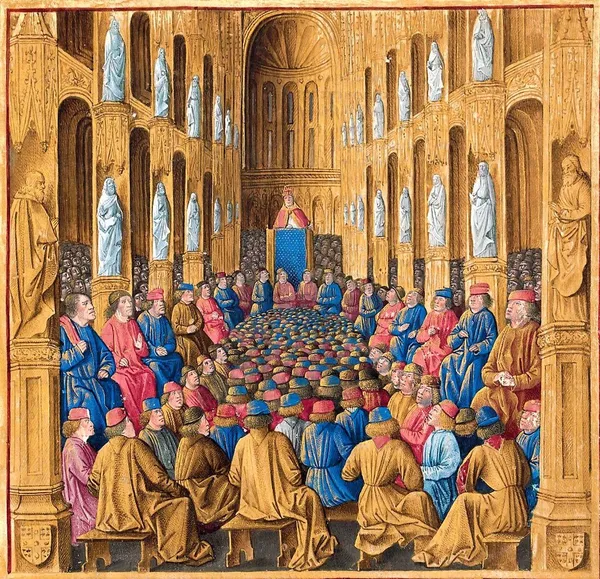
The Crusading movement was a major religious, political, and military endeavour of the Middle Ages, generally dated from the Council of Clermont (1095), at which Pope Urban II proclaimed the First Crusade, an armed expedition in support of Eastern Christians under Muslim rule. He framed it as a form of penitential pilgrimage. By this point, papal authority had grown through church reforms, and tensions with secular rulers encouraged the notion of holy war—combining classical just war theory, biblical precedents, and Augustine's teachings on legitimate violence. Armed pilgrimage aligned with the era's Christocentric and militant Catholicism, sparking widespread enthusiasm. Western expansion was further enabled by economic growth, the decline of older Mediterranean powers, and Muslim disunity. These factors allowed crusaders to seize territory and found four Crusader states in the Levant, whose defence inspired successive Crusades. The papacy also launched crusading campaigns against other targets—Muslims in Iberia, paganism in the Baltics, and other opponents of papal authority. Though aimed primarily at the warrior elite through appeals to chivalric ideals, the movement depended on broad support from clergy, townspeople, and peasants. Women, despite being discouraged, were involved as participants, proxies for absent crusaders, or victims. Although many crusaders were motivated by indulgences (absolution from sins), material gain also played a part. Crusading campaigns were typically initiated through papal bulls, and participants pledged to join by "taking the cross"—sewing a cross onto their garments. Failure to fulfil vows could result in excommunication. Periodic waves of zeal produced unsanctioned "popular crusades". The papal-sanctioned wars fostered distinctive institutions and ideologies. Initially funded through improvised means, later campaigns received more organized support via papal taxes on clergy and the sale of indulgences. Core crusading forces were heavily armed knights, backed by infantry, local troops, and naval aid from maritime cities. Crusaders secured their holdings by building strong castles, and the fusion of chivalric and monastic ideals led to the rise of military orders. The movement extended Western Christendom and created new frontier states, some of which survived into the early modern period.
Also on this shelf
Grace Church (Providence, Rhode Island).
Culture of medieval Poland.
See also
Uncatalogued shelfText from Wikipedia; plate via Wikimedia Commons. Text CC BY-SA 4.0; plate freely licensed (see Commons). Source record. Images and catalogue data are reproduced from open-access collections.