Medieval and Manuscripts
Byzantine bureaucracy and aristocracy
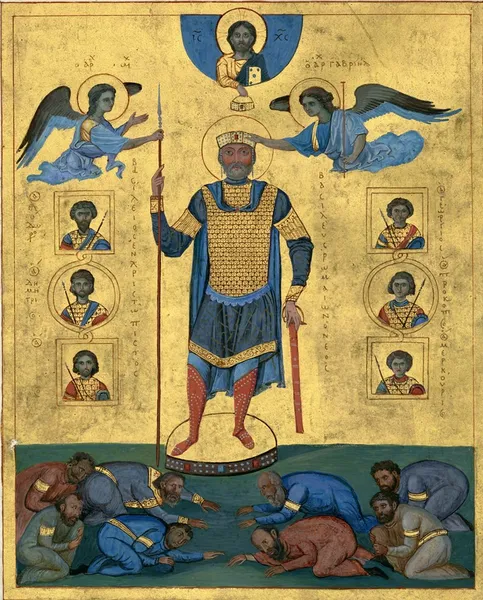
Throughout the fifth century, Hellenistic-Eastern political systems, philosophies, and theocratic Christian concepts had gained power in the Greek-speaking Eastern Mediterranean due to the intervention of important religious figures there such as Eusebius of Caesarea (c. 260 – c. 339) and Origen of Alexandria (c. 185 – c. 253) who had been key to developing the constant Christianized worldview of late antiquity. By the 6th century, such ideas had already influenced the definitive power of the monarch as the representative of God on earth and of his kingdom as an imitation of God's holy realm. The Byzantine Empire was a multi-ethnic monarchic theocracy adopting, following, and applying the Christian Orthodox-Hellenistic political systems and philosophies. The monarch was the incarnation of the law—nomos empsychos—and his power was immeasurable and divine in origin insofar as he channeled God's divine grace, maintaining what is good. He was the ultimate benefactor, caretaker, and saviour of the people: Evergétis, Philanthrōpía, and Sōtēr, anointed with all power, upholding the divine laws since he ought to emulate Christ first (christomimetes) in all of his divine, pious, loving orthodox attributes to all by being his earthly presence. The people in turn were the monarch's paroikoi (subjects). He was the sole administrator and lawgiver of the holy Basileia and Oikoumene (commonwealth), with sole power over the state, the land, and his subjects, which he had achieved through God's appointment of him as king. This opened a new stage of reverence in which Hellenistic and Eastern court ceremonies such as proskynesis highlighted the divinity of the ruler and became standardized and often mandatory. In practice, imperial power was exercised as administration—simplified and centralized through viceroys such as the Exarchos, Douk, Katepánō, Kephalai and the Strategoi who enjoyed the same omnipotence and the emperor's God given dignity in their respective governorships. Such concentrations of power proved to be both an internal weakness and the cause of various coups and rebellions in which viceroys with provincial armies and, sometimes, entire themes, would often challenge imperial power with claims of their own.
Also on this shelf
Erfurt Cathedral.
Chapter house.
See also
Uncatalogued shelfText from Wikipedia; plate via Wikimedia Commons. Text CC BY-SA 4.0; plate freely licensed (see Commons). Source record. Images and catalogue data are reproduced from open-access collections.