Medieval and Manuscripts
Archimedes Palimpsest
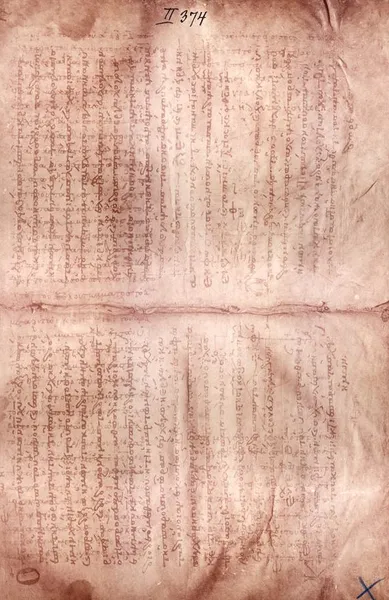
The Archimedes Palimpsest is a parchment codex palimpsest, originally a Byzantine Greek copy of a compilation of Archimedes and other authors. It contains two works of Archimedes that were thought to have been lost (the Ostomachion and the Method of Mechanical Theorems) and the only surviving original Greek edition of his work On Floating Bodies. The first version of the compilation is believed to have been produced by Isidore of Miletus, the architect of the geometrically complex Hagia Sophia cathedral in Constantinople, sometime around AD 530. The copy found in the palimpsest was created from this original, also in Constantinople, during the Macedonian Renaissance (c. AD 950), a time when mathematics in the capital was being revived by the former Greek Orthodox bishop of Thessaloniki Leo the Geometer, a cousin of the Patriarch. Following the sack of Constantinople by Western crusaders in 1204, the manuscript was taken to an isolated Greek monastery in Palestine, possibly to protect it from occupying Crusaders, who often equated Greek script with heresy against their Latin church and either burned or looted many such texts (including two additional copies of Archimedes' writing, at least). The complex manuscript was not appreciated at this remote monastery and was soon scraped, washed and overwritten (1229) with a religious text (palimpsesting is the name of this process of cleaning and reusing old parchment). In 1899, nine hundred years after it was written, the manuscript was still in the possession of the Greek church, and back in Istanbul (the former Constantinople), where it was catalogued by the Greek scholar Papadopoulos-Kerameus, attracting the attention of Johan Heiberg. Heiberg visited the church library and was allowed to make detailed photographs in 1906. Most of the original text was still visible, and Heiberg published it in 1915. In 1922, the manuscript went missing in the midst of the evacuation of the Greek Orthodox library in Istanbul, during a tumultuous period following World War I. A Western businessman concealed the book for over 70 years, and at some point forged pictures were painted on top of some of the text to increase resale value. Unable to sell the book privately, in 1998, the businessman's daughter risked a public auction in New York contested by the Greek church; the U.S.
Also on this shelf
Gesta Hungarorum.
Gesu Church (Milwaukee, Wisconsin).
See also
Uncatalogued shelfText from Wikipedia; plate via Wikimedia Commons. Text CC BY-SA 4.0; plate freely licensed (see Commons). Source record. Images and catalogue data are reproduced from open-access collections.