Medieval and Manuscripts
Interlace (art)
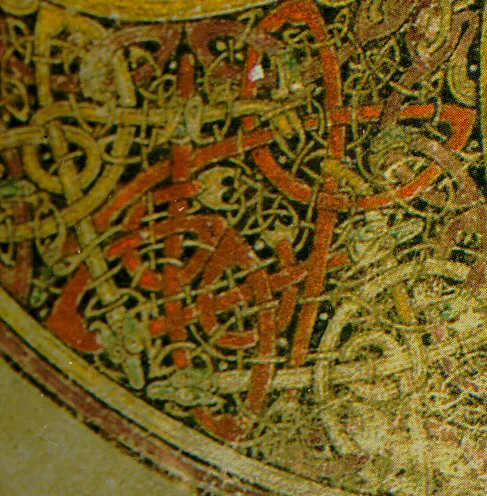
In the visual arts, interlace is a decorative element found in medieval art. In interlace, bands or portions of other motifs are looped, braided, and knotted in complex geometric patterns, often to fill a space. Interlacing is common in the Migration period art of Northern Europe, in the early medieval Insular art of Britain and Ireland, and Norse art of the Early Middle Ages, and in Islamic art. Intricate braided and interlaced patterns, called plaits in British usage, first appeared in late Roman art in various parts of Europe, in mosaic floors and other media. Coptic manuscripts and textiles of 5th- and 6th-century Christian Egypt are decorated with broad-strand ribbon interlace ornament bearing a "striking resemblance" to the earliest types of knotwork found in the Insular art manuscripts of Ireland and the British Isles.
Also on this shelf
Central Park Casino.
Gesu Church (Milwaukee, Wisconsin).
See also
Uncatalogued shelfText from Wikipedia; plate via Wikimedia Commons. Text CC BY-SA 4.0; plate freely licensed (see Commons). Source record. Images and catalogue data are reproduced from open-access collections.