Medieval and Manuscripts
Celts
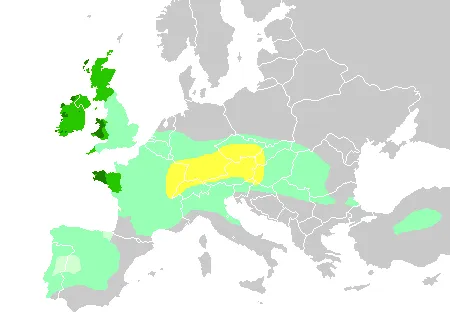
The Celts ( KELTS, see pronunciation for different usages) or Celtic peoples ( KEL-tik) were a collection of Indo-European peoples in Europe and Anatolia, identified by their use of Celtic languages and other cultural similarities. Major Celtic groups included the Gauls; the Celtiberians and Gallaeci of Iberia; the Britons, Picts, and Gaels of Britain and Ireland; the Boii; and the Galatians. The interrelationships of ethnicity, language and culture in the Celtic world are unclear and debated; for example over the ways in which the Iron Age people of Britain and Ireland should be called Celts. In current scholarship, "Celt" primarily refers to speakers of Celtic languages, not to a single ethnic group. The history of pre-Celtic Europe and Celtic origins is debated. The traditional "Celtic from the East" theory, says the proto-Celtic language arose in the late Bronze Age Urnfield culture of central Europe, named after grave sites in southern Germany, which flourished from around 1200 BC. This theory links the Celts with the Iron Age Hallstatt culture which followed it (c. 1200–500 BC), named for the rich grave finds in Hallstatt, Austria, and with the following La Tène culture (c. 450 BC onward), named after the La Tène site in Switzerland. It proposes that Celtic culture spread westward and southward from these areas by diffusion or migration. A newer theory, "Celtic from the West", suggests proto-Celtic arose earlier, was a lingua franca in the Atlantic Bronze Age coastal zone, and spread eastward. Another newer theory, "Celtic from the Centre", suggests proto-Celtic arose between these two zones, in Bronze Age Gaul, then spread in various directions. After the Celtic settlement of Southeast Europe in the 3rd century BC, Celtic culture reached as far east as central Anatolia, Turkey. The earliest undisputed examples of Celtic language are the Lepontic inscriptions from the 6th century BC. Continental Celtic languages are attested almost exclusively through inscriptions and place-names. Insular Celtic languages are attested from the 4th century AD in Ogham inscriptions, though they were being spoken much earlier. Celtic literary tradition begins with Old Irish texts around the 8th century AD. Elements of Celtic mythology are recorded in early Irish and early Welsh literature.
Also on this shelf
Came glasswork.
Christianisation of Scotland.
See also
Uncatalogued shelfText from Wikipedia; plate via Wikimedia Commons. Text CC BY-SA 4.0; plate freely licensed (see Commons). Source record. Images and catalogue data are reproduced from open-access collections.