Medieval and Manuscripts
Arab Christians
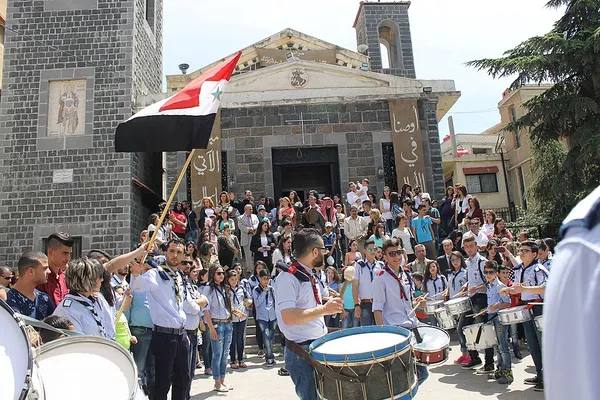
Arab Christians (Arabic: الْمَسِيحِيُّون الْعَرَب, romanized: al-Masīḥiyyūn al-ʿArab) are the Arabs who adhere to Christianity. The number of Arab Christians who live in the Middle East was estimated in 2012 to be between 10 and 15 million, although most predominant in Lebanon. Arab Christian communities can be found throughout the Arab world, but are concentrated in the Eastern Mediterranean region of the Levant and Egypt, with smaller communities present throughout the Arabian Peninsula and North Africa. The history of Arab Christians begins with the history of Christianity in pre-Islamic Arabia, which coincides with the history of Eastern Christianity and the history of the Arabic language. Arab Christian communities either result from pre-existing Christian communities adopting the Arabic language, or from pre-existing Arabic-speaking communities adopting Christianity. The jurisdictions of three of the five patriarchates of the Pentarchy primarily became Arabic-speaking after the early Muslim conquests – the Church of Alexandria, the Church of Antioch and the Church of Jerusalem – and over time many of their adherents adopted the Arabic language and culture. Separately, a number of early Arab kingdoms and tribes adopted Christianity, including the Nabataeans, Lakhmids, Salihids, Tanukhids, Ibadis of al-Hira, and the Ghassanids. In modern times, Arab Christians have played important roles in the Nahda movement, and they have significantly influenced and contributed to the fields of literature, politics, business, philosophy, music, theatre and cinema, medicine, and science. Today Arab Christians still play important roles in the Arab world, and are relatively wealthy, well educated, and politically moderate. Emigrants from Arab Christian communities also make up a significant proportion of the Middle Eastern diaspora, with sizable population concentrations across the Americas, most notably in Brazil, Argentina, Venezuela, Colombia, and the US.
Also on this shelf
David Lyndsay.
Basilica of Our Lady Immaculate.
See also
Uncatalogued shelfText from Wikipedia; plate via Wikimedia Commons. Text CC BY-SA 4.0; plate freely licensed (see Commons). Source record. Images and catalogue data are reproduced from open-access collections.