Medieval and Manuscripts
Barnabas
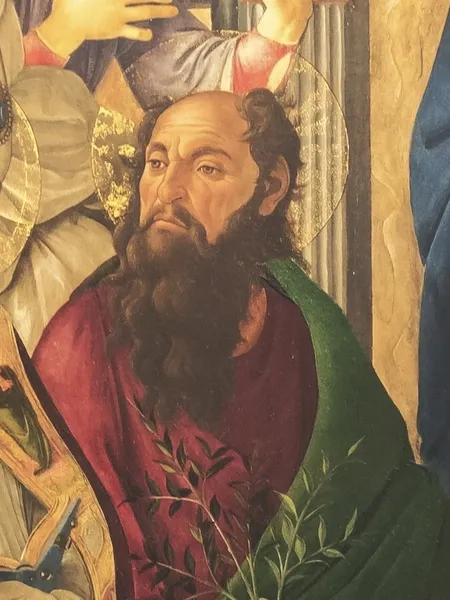
Barnabas (; Ancient Greek: Βαρναβᾶς; Syriac: ܒܪܢܒܐ), born Joseph (Ἰωσήφ) or Joses (Ἰωσής), was a prominent Christian disciple, identified as an apostle in Acts 14:14. According to Acts 4:36, he was a Cypriot Levite. He undertook missionary journeys as a companion of Paul the Apostle, evangelizing among the "God-fearing" Gentiles who attended synagogues in some of the Hellenized cities of Anatolia. He participated in the Council of Jerusalem (c. 49 AD). Barnabas' story appears in the Acts of the Apostles, and Paul mentions him in some of his epistles. Tertullian named him as the author of the Epistle to the Hebrews, but this and other attributions are conjecture. The Epistle of Barnabas was ascribed to him by Clement of Alexandria and others in the early church and the epistle is included under his name in Codex Sinaiticus, the earliest extant manuscript of the complete New Testament. A minority of modern scholars concur with this traditional attribution. Christian tradition holds that Barnabas was martyred at Salamis, Cyprus. He is traditionally identified as the founder of the Cypriot Orthodox Church. The feast day of Barnabas is celebrated on 11 June. Barnabas is usually identified as the cousin of Mark the Evangelist on the basis of the term "anepsios" used in Colossians 4, which carries the connotation of "cousin". Orthodox tradition holds that Aristobulus of Britannia, one of the Seventy Disciples, was the brother of Barnabas.
Also on this shelf
Church of Saint-Éloi, Dunkirk.
Biblioteca Marciana.
See also
- ▸Albanian heraldry
- ▸Curtis and Davis Architects and Engineers
- ▸Church of the Incarnation, Roman Catholic (Manhattan)
Text from Wikipedia; plate via Wikimedia Commons. Text CC BY-SA 4.0; plate freely licensed (see Commons). Source record. Images and catalogue data are reproduced from open-access collections.